Dr. Strangelove or: How I Learned to Stop Worrying and Love the Bomb
Writers: Stanley Kubrick (screenplay), Terry Southern (screenplay), Peter George (screenplay)
Based on: "Red Alert" by Peter George (1958) ↗
Cast: Peter Sellers, George C. Scott, Sterling Hayden, Slim Pickens, Keenan Wynn, James Earl Jones
Brigadier General Jack D. Ripper, convinced that Communist conspiracies are contaminating American 'precious bodily fluids,' orders a nuclear first strike on the Soviet Union using a contingency plan designed to bypass normal chains of command. In the War Room, President Muffley and his advisors discover that the Soviet Union has built a Doomsday Machine — an automated total-retaliation device triggered by any nuclear explosion on Soviet soil — and that it cannot be recalled, negotiated with, or switched off, because the whole point of an automated deterrent is that it removes human judgement from the loop.
The Doomsday Machine is the purest argument ever staged about automated systems, and it is worth being precise about what the argument actually is. The device works by removing human judgement from the decision to retaliate: any nuclear explosion on Soviet soil triggers total, automatic, irrevocable annihilation, with no override and no appeal. President Muffley asks the only sane question available — how is it possible for this thing to be triggered automatically, and at the same time impossible to untrigger? — and Strangelove's answer is not a defence of a mistake. It is an explanation of a feature. Because of the automated and irrevocable decision-making process which rules out human meddling, the Doomsday Machine is terrifying, simple to understand, and completely credible and convincing. The insanity here is not located in the automation. It is in the premise the automation serves: that a system's value comes from the impossibility of overriding it. Every automated escalation mechanism ever built rests on some version of that premise. Auto-scaling, automated trading, moderation at scale, circuit breakers that trip without asking — their worth lies in the speed and certainty of the response, which means the worth evaporates the moment a human is allowed to intervene. The Doomsday Machine is simply the endpoint of that reasoning, drawn to its full length so we can see where the line goes.
Plan R was designed for a legitimate edge case. Turgidson describes it without embarrassment: an emergency war plan in which a lower echelon commander may order nuclear retaliation after a sneak attack if the normal chain of command has been disrupted. That is a real problem with no easy answer. If Washington is destroyed in the first minutes of a war, someone further down must be able to act, or the deterrent is hollow. Ripper uses that provision to launch a first strike. Nothing malfunctions. No safeguard is broken, no code is cracked, no procedure is skipped. The system works exactly as designed — the failure is in the design, which described a scenario broad enough to encompass a commander going mad and then treated it as indistinguishable from legitimate decapitation. Turgidson's reply when this is pointed out is the most honest line in the film precisely because it is so unreflective: I don't think it's quite fair to condemn a whole program because of a single slip-up, sir. Every contingency plan carries this liability. The more scenarios it covers, the more handles it offers to anyone who wants to misuse it, and the coverage is what everyone is proud of.
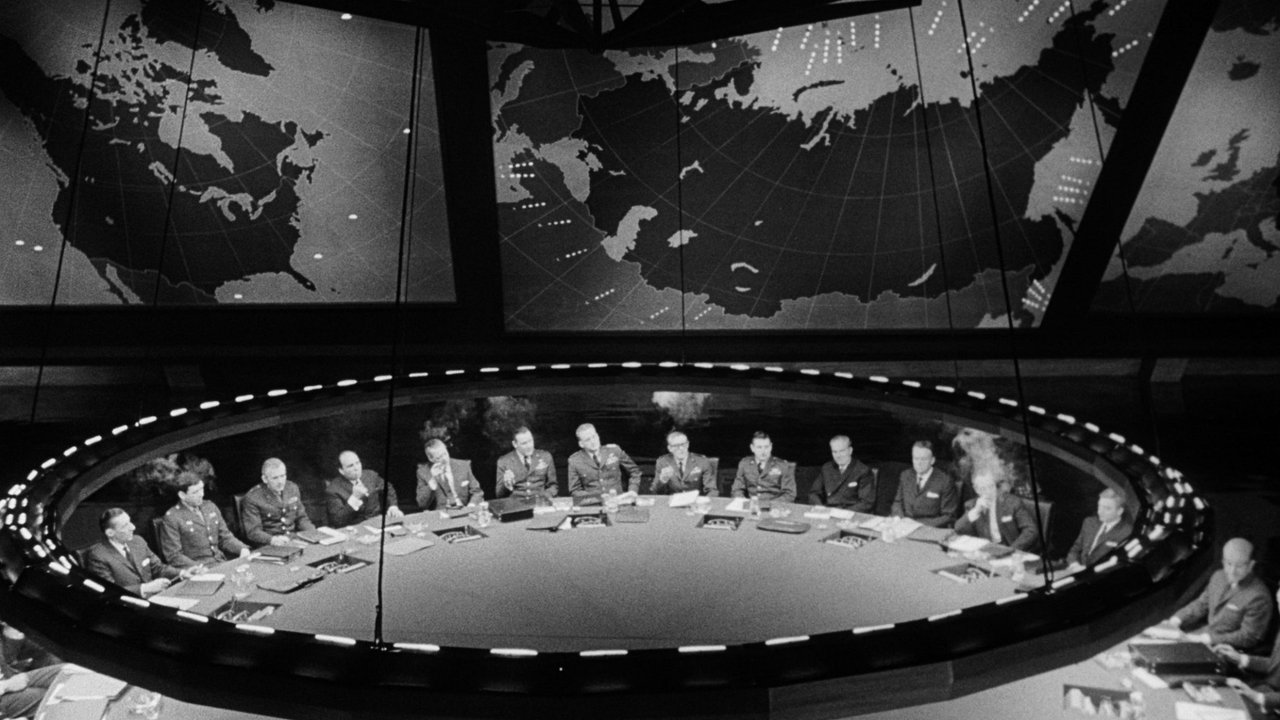
Then there is the War Room, which is the film's structural claim rather than its comedy. The President, the Joint Chiefs, the Soviet Ambassador and a room full of the best available information are gathered in one place, and they can do nothing at all. The bombers are in the air. The recall codes are wrong and locked inside one man's head. The Soviet Premier is drunk. The Doomsday Machine cannot be turned off, and Strangelove explains why turning it off was never on the table. The most powerful people alive have less agency over the outcome than a single deranged general sitting in a locked office at Burpelson. Kubrick shoots the room as a place of total visibility and total impotence — everyone can see the board, nobody can move a piece. What the film is claiming is not that leaders are foolish, though several of them are. It is that systems designed to be irreversible achieve irreversibility for everyone, including the people who designed them and the people they were meant to protect. Irrevocability is not a property you can aim at your adversaries alone.
And the sharpest line in the film is also the smallest. The whole point of the Doomsday Machine is lost if you keep it a secret. De Sadeski's explanation, when Strangelove demands to know why the world was never told, is that the announcement was scheduled for the Party Congress on Monday, because the Premier loves surprises. A deterrent nobody knows about deters nothing. The Machine was funded, built, buried, armed, automated and wired to fire — and the one remaining step, the step that would have made the entire apparatus function as intended, was left in a calendar. The most consequential system ever constructed, defeated at the last mile by a communications failure. Anyone who has shipped something correct and complete that nobody was told about knows the feeling, though usually with lower stakes. The engineering was never the hard part. The hard part was the sentence that had to be said out loud to someone outside the building, and it kept getting deferred to Monday.