Paths of Glory
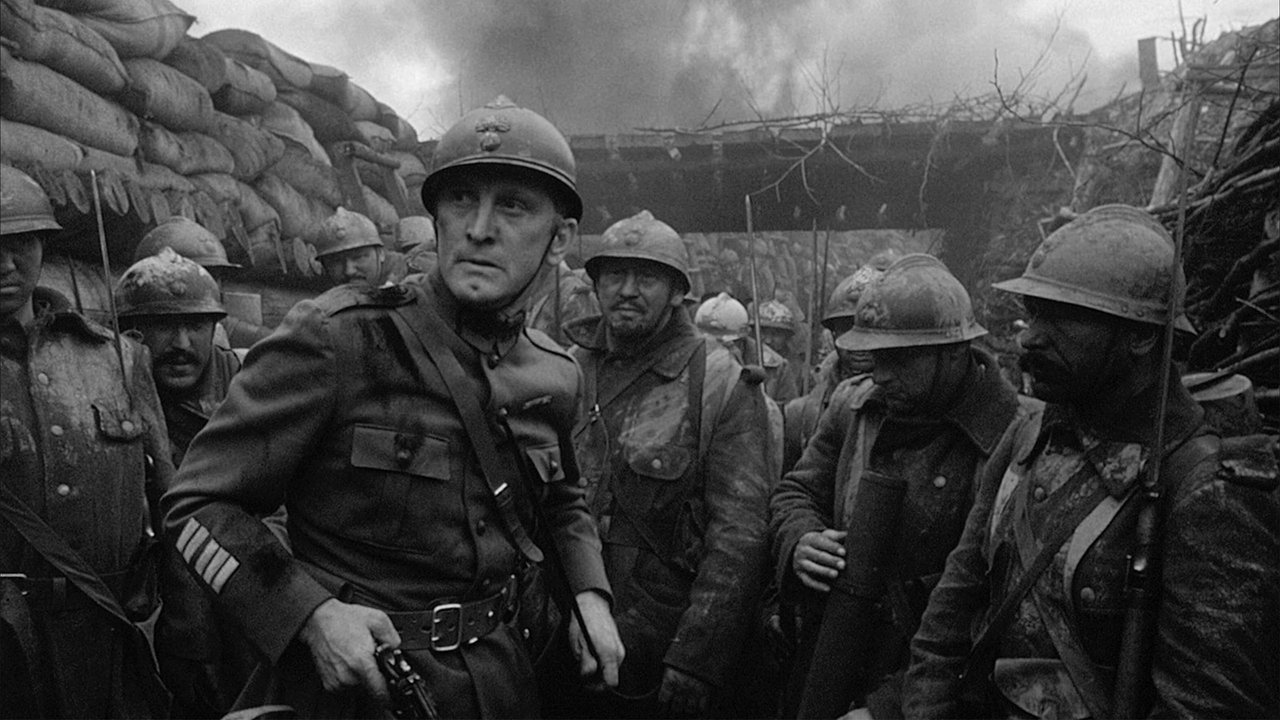
Writers: Stanley Kubrick (screenplay), Calder Willingham (screenplay), Jim Thompson (screenplay)
Based on: "Paths of Glory" by Humphrey Cobb (1935) ↗
Cast: Kirk Douglas, Ralph Meeker, Adolphe Menjou, George Macready, Wayne Morris, Richard Anderson, Joe Turkel, Timothy Carey
During World War I, French General Mireau orders his regiment to take an impregnable German position called the Anthill. When the attack fails — as everyone except Mireau knew it would — he demands that three soldiers be court-martialled and executed for cowardice, to deflect from the fact that the order should never have been given. Colonel Dax, who led the attack and is also a criminal lawyer, defends them in a trial whose verdict was decided before the proceedings began.
The attack on the Anthill is ordered by General Mireau, who initially refuses the mission as impossible and then accepts it within sixty seconds of learning that a promotion accompanies success. This is not a scene about corruption, though it contains it. It is a scene about how organisations make decisions that no individual inside them would describe as their own. Mireau does not decide to send men to die for his career; he decides that the attack is, on reflection, feasible, and once feasibility is established the rest follows procedurally. The moment the assessment changes from impossible to possible, the order becomes an obligation rather than a choice, and the general becomes a man doing his job rather than a man doing harm. Kubrick stages the conversation between Mireau and Broulard with a kind of social precision that reveals how thoroughly an institutional process can metabolise something monstrous and return it as routine. The promotion is not a bribe; it is context. The feasibility assessment is not a lie; it is a revised judgement. The order is not reckless; it is ambitious. Each step, described in the vocabulary available to the men taking it, is defensible. The sequence as a whole is an atrocity. This is how organisations produce outcomes that nobody in them intended and everybody in them enabled, and it has nothing to do with evil.
The court-martial occupies the centre of the film, and it deserves close attention for what it is not. It is not a scene in which justice miscarries. A miscarriage implies a system that was meant to produce justice and failed; what Kubrick shows is a system that was never designed to answer the question it appears to be asking. The three accused are not selected for any quality they possess — one is chosen by lot, one by personal grudge, one for being socially expendable. The trial is not conducted to determine whether they were cowardly; it is conducted to produce the finding that someone was, because that finding is what the hierarchy requires. If the men have been ordered to attack, and some of them don't, they're guilty of cowardice, aren't they? Mireau's question contains its own answer and forecloses every other. Colonel Dax mounts a defence and it is competent, even impassioned — there are times that I'm ashamed to be a member of the human race and this is one such occasion — but the film makes clear that competence is irrelevant when the proceeding exists to confirm a conclusion rather than to reach one. The judges do not deliberate because there is nothing to deliberate about. The accusation is the verdict; the trial is the paperwork between them. Anyone who has watched a post-mortem where the responsible party controls the investigation recognises the architecture instantly.
What makes the film cut deeper than a simple anti-war argument is its precision about where the failure sits. It is not in the cruelty of individual officers, though Mireau is vain and Broulard is cynical. It is in the structure that connects an impossible order to an inevitable execution through a chain of steps each of which is procedurally correct. Mireau orders the attack; the attack fails; the failure requires an explanation; the explanation must not implicate the order; therefore the explanation must implicate the men who received it. The soldiers are not scapegoats in the colloquial sense — they are not being blamed for someone else's crime. They are the output of a process that was designed to protect the hierarchy from the consequences of its own decisions and is now functioning as designed. Broulard, the most senior officer in the film, watches the executions with something close to satisfaction, not because he is sadistic but because the system has demonstrated that it works. The problem has been resolved. Accountability has been assigned. The hierarchy remains intact. The men died wonderfully, he says afterward, and the line is so grotesque it sounds like satire, but within the logic of the institution it is a performance review.
Kubrick ends the film with a scene that has nothing to do with the military hierarchy and everything to do with what the hierarchy cannot reach. A captured German girl is pushed onto a stage in a tavern full of French soldiers, who jeer and howl at her. She begins to sing, haltingly, and the room falls silent. The soldiers, who minutes ago were an audience for cruelty, begin to cry. They hum along. They do not know the words, but they recognise the melody as something from before all of this. Kubrick holds the shot and lets it play out without comment. Dax watches from outside, and for a moment considers interrupting to order the men back to the front, then does not. The scene is not a redemption; Kubrick is too precise for that. It is a remainder. The organisation can use them and it can discard them, but it cannot hold the fact that they weep, because weeping is not a field the system was built to contain.