Idiocracy
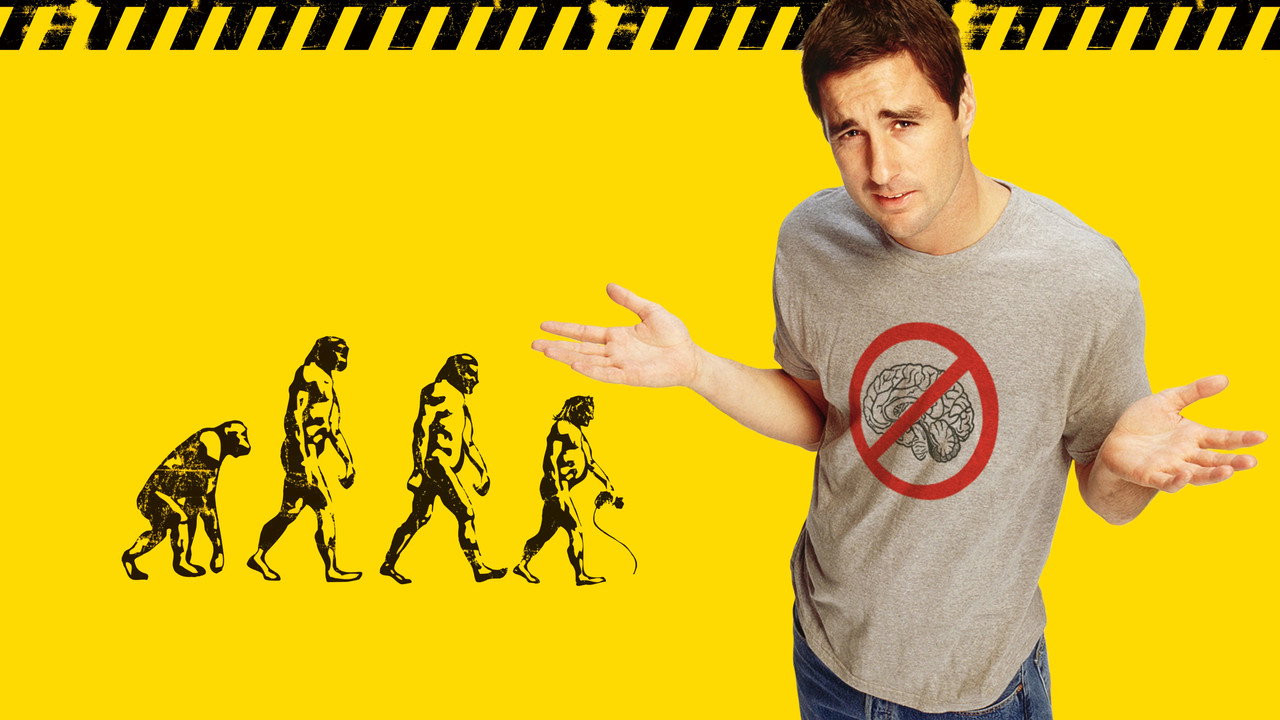
Writers: Mike Judge (screenplay & story), Etan Cohen (screenplay)
Cast: Luke Wilson, Maya Rudolph, Dax Shepard, Terry Crews, David Herman, Justin Long
Corporal Joe Bauers, selected by the US Army for a hibernation experiment precisely because he is the most average man it can find, is frozen for a year and forgotten for five hundred. He wakes in 2505 to a country whose population has been shaped by centuries of reproductive selection against intelligence: the language has degraded, crops are irrigated with a sports drink, the President is a former wrestler, and Joe's unremarkable vocabulary marks him as the smartest person alive. Sentenced, then promoted to Secretary of the Interior, he is given an impossible brief — fix the food supply — by an institution that still has every lever it ever had and no memory of what any of them were for.
Idiocracy is remembered as a film about stupid people, which is the least interesting thing in it and probably why the film is quoted more often than it is understood. The narration frames the premise as a selection story: a mechanism that once rewarded certain traits stops rewarding them, not because anyone decided to change it but because the conditions that made those traits pay went away. That is a precise description of what happens to metrics inside institutions. A measure is adopted because it correlates with something the organisation actually cares about; the correlation is real for a while; and then the environment shifts, the pressure that maintained the link disappears, and the measure carries on being optimised with total fidelity to a target that no longer means anything. The film's five hundred years of drift are just the timescale required to make visible something that normally happens over three or four reorganisations.
What is genuinely unnerving is how well everything still runs. Judge's future is not a ruin. The stores are open, the highways carry traffic, the healthcare system has diagnostic machines, the President delivers a state of the union to a full stadium. The narration's line about mankind becoming stupider at a frightening rate is played over a world in which the infrastructure has, if anything, become smoother. This is the film's real thesis and it is the opposite of the one people take from it: complex systems do not need anybody to understand them in order to keep operating. They need the interfaces maintained and the rituals performed. The greeter at the door who says "welcome to Costco, I love you" is not a joke about warmth being cheapened. It is a joke about a script that has outlived every person who knew why it was written, delivered flawlessly, forever.
The Brawndo sequence is the best single dramatisation of circular institutional justification I know of in any medium. The crops are dying. Joe suggests water. The cabinet explains that the fields are irrigated with Brawndo because Brawndo has electrolytes; asked what electrolytes are, they answer that electrolytes are what they use to make Brawndo. The loop is closed and airtight, and no one inside it is lying or even being lazy. Each of them can give a correct answer to the question one level down. Nobody can give an answer at the bottom, because the bottom was a marketing claim that got promoted into an engineering requirement several centuries earlier and nobody has been able to see the seam since. Every organisation over a certain age has a Brawndo. It is usually a field in a database, a step in a release process, or a threshold in an alert, and its defence is always the same: this is how it is done, and we do it this way because this is how it is done.
President Camacho is the film's most generous character and its most damning idea. He knows the situation is bad — he lists the starvation and the dust storms and the shortages accurately, which is more than most of his cabinet manages — and his instinct is to find someone who might actually fix it and hand them the authority. That instinct is sound. What he cannot supply is the thing his office has lost, which is any institutional capacity to distinguish a solution from a performance, so Joe's correct diagnosis and Joe's near-execution follow from the same process within about a week of each other. This is where the film stops being a comedy about decline and becomes a comedy about governance. The failure is not that nobody is clever enough. It is that the machinery for turning a right answer into an implemented decision has quietly rotted while every visible part of the state carried on functioning — and a civilisation, like a product organisation, can lose that machinery long before anyone notices the lights are still on.