설국열차
Writers: Bong Joon-ho (screenplay), Kelly Masterson (screenplay), Jacques Lob (graphic novel), Benjamin Legrand (graphic novel), Jean-Marc Rochette (graphic novel)
Cast: Chris Evans, Song Kang-ho, Tilda Swinton, Jamie Bell, Octavia Spencer, John Hurt, Ed Harris
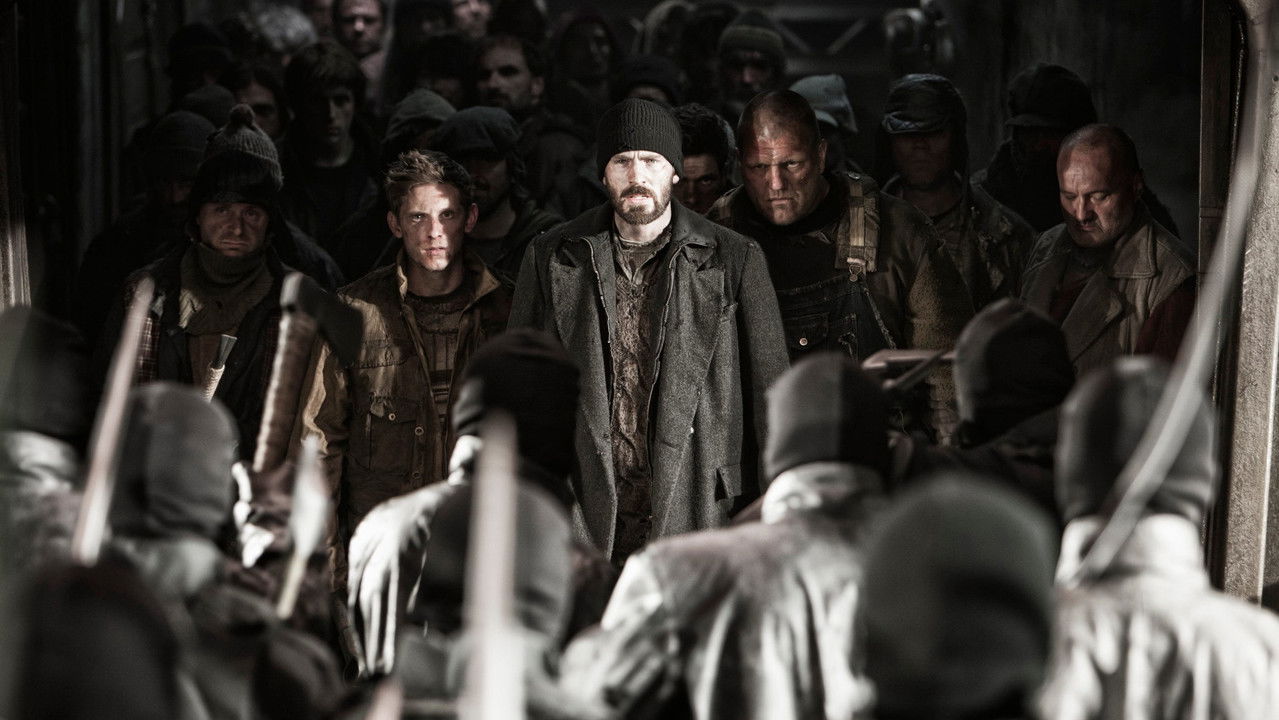
In a frozen future caused by a failed climate engineering experiment, the last survivors of humanity live aboard a perpetually circling train divided into rigid class compartments. Curtis Everett leads a rebellion from the squalid tail section toward the engine at the front, discovering with each car he crosses a new layer of the system that keeps the train — and its social order — running.
The train is a closed system, and Bong Joon-ho organises his film as a traversal of it. Curtis Everett starts in the tail section — dark, cramped, fed on gelatinous protein bars whose ingredients nobody asks about — and fights his way forward, car by car, toward the engine. Each car he enters reveals a new function of the system: water purification, protein manufacture, an aquarium, a greenhouse, a school, a sushi bar, a nightclub, a sauna. The tour is the film's structural method and its argument. You cannot understand the system from the tail, because the tail is designed to be illegible from within — its residents know they are at the bottom but they do not know what the top looks like, and without that knowledge they cannot form a picture of what they are at the bottom of.
Curtis's revolution is also an education, and the education is more destabilising than the violence, because each car reveals not just luxury but function: the squalor of the tail is not an oversight of the system but a feature of it, a compartment that serves the same purpose as any other compartment, which is to keep the engine running. The protein bars are made from ground insects — a fact that provokes disgust when revealed — but the disgust is misplaced, because the bars work, they sustain life, and the real obscenity is not what the tail eats but that eating it is the designed output of a resource allocation model that also produces sushi for the front. The system does not have a failure. It has a distribution.
Minister Mason delivers the film's most explicit statement of ideology, and she does it with a shoe. She holds a shoe above her head and asks whether you would wear it as a hat. You would not. A shoe belongs on the foot, a hat belongs on the head, and she is a hat, and they are shoes. The speech is idiotic, and it is idiotic on purpose — Bong is showing that the ideological justification for hierarchy does not need to be sophisticated, it needs to be repeated. Mason does not argue for the natural order; she declares it and performs outrage at the suggestion that it could be otherwise.
Order, she says, is the barrier that holds back the flood of death. The metaphor is hydraulic — chaos as pressure, hierarchy as containment — and it functions because the passengers have no competing metaphor, and because the train is actually moving, which gives the metaphor a literal ground it does not deserve. If the engine stops, they freeze. This is true. It does not follow that the person who controls the engine should eat sushi while the person in the tail eats insects, but the true premise about the engine lends its force to the false conclusion about the sushi, and that transference is how ideology works in every closed system. Mason believes what she is saying, which makes her more useful to the system than someone who did not, because sincerity is more sustainable than cynicism over the long duration of a perpetually circling train.
The twist arrives when Curtis reaches the engine and meets Wilford, and it is the most cynical thing the film has to say about organisational design. The revolution was not a failure of the system. It was a function of the system. Wilford and Gilliam — Curtis's mentor, the elder statesman of the tail, the man who inspired the uprising — had been in communication the entire time. The revolutions are periodic, planned, calibrated. They serve as a population-control mechanism: the tail grows, resources become strained, a revolution is permitted to progress far enough to reduce the population to sustainable levels, and then it is contained. The rebels die believing they were fighting the system, and their deaths are the system's maintenance cycle. Curtis was selected, groomed, positioned — not to overthrow Wilford but to replace him, to sit in the engine room and manage the next cycle. This is the complete model: a closed organisation in which dissent is not a threat to the structure but a scheduled input, where rebellion is a feature rather than a bug, where the appearance of resistance is manufactured to absorb the energy that would otherwise produce actual resistance. Every institution that has ever channelled employee frustration into a feedback survey, published the results in a newsletter, changed nothing, and called it listening has performed a smaller version of Wilford's manoeuvre.
Curtis refuses the engine, and Namgoong blows the door. The train derails. Two children — Yona and Timmy — walk out into the snow, and in the distance a polar bear moves across the ice, which means the world outside is no longer as dead as the system required them to believe. The ending is not triumphant; most of the passengers are dead, the survivors are two children with no tools, and the bear is as likely to eat them as to signify hope. But Bong's point is not that freedom is safe. It is that the engine was never the only option — it was merely the only option visible from inside the train. The system's most powerful achievement was the claim that outside was uninhabitable, that the only choice was between this order and death, and that therefore every cruelty was a mercy. The train was a total institution in the sociological sense: it controlled not just the bodies of its passengers but the boundaries of the thinkable, and the revolution that mattered was not the one that moved from car to car but the one that moved from the train to the snow.