The China Syndrome
Writers: Mike Gray (writer), T.S. Cook (writer), James Bridges (writer)
Cast: Jane Fonda, Michael Douglas, Jack Lemmon, Scott Brady, James Hampton, Peter Donat
While doing a series of reports on alternative energy sources, opportunistic reporter Kimberly Wells witnesses an accident at a nuclear power plant. Wells is determined to publicize the incident, but soon finds herself entangled in a sinister conspiracy to keep the full impact of the incident a secret.
The China Syndrome is built around a single structural irony: the people best positioned to know whether a nuclear plant is safe are precisely the people with the most to lose from saying it is not. Jack Godell (Jack Lemmon) is a shift supervisor, a craftsman in the exact sense the collection values — someone whose competence is real, whose instincts are calibrated, who recognises the vibration in a pump before the instruments confirm it. The film's central argument is not that nuclear power is dangerous, but that the organisational conditions around it make honest risk assessment nearly impossible. Godell does not start as a whistleblower. He starts as a loyal employee who believes the system works. The film traces, with clinical patience, the process by which he learns it does not.
The corporate and regulatory machinery depicted in the film is not conspiratorially evil — it is something more troubling: structurally optimised for the suppression of bad news. When Godell flags the faulty weld x-rays, he is met not with denial but with institutional momentum. Schedules, budgets, careers, and the shared understanding that the plant is safe have already committed everyone upstream to a conclusion. The film understands, as few thrillers do, that most cover-ups are not orchestrated from the top down but emerge from the bottom up — nobody orders the problem hidden; the problem is simply never surfaced in a form that requires acknowledgment. This is emergence in its most consequential form: a dangerous system maintained not by villains but by the ordinary incentive structures of large organisations.
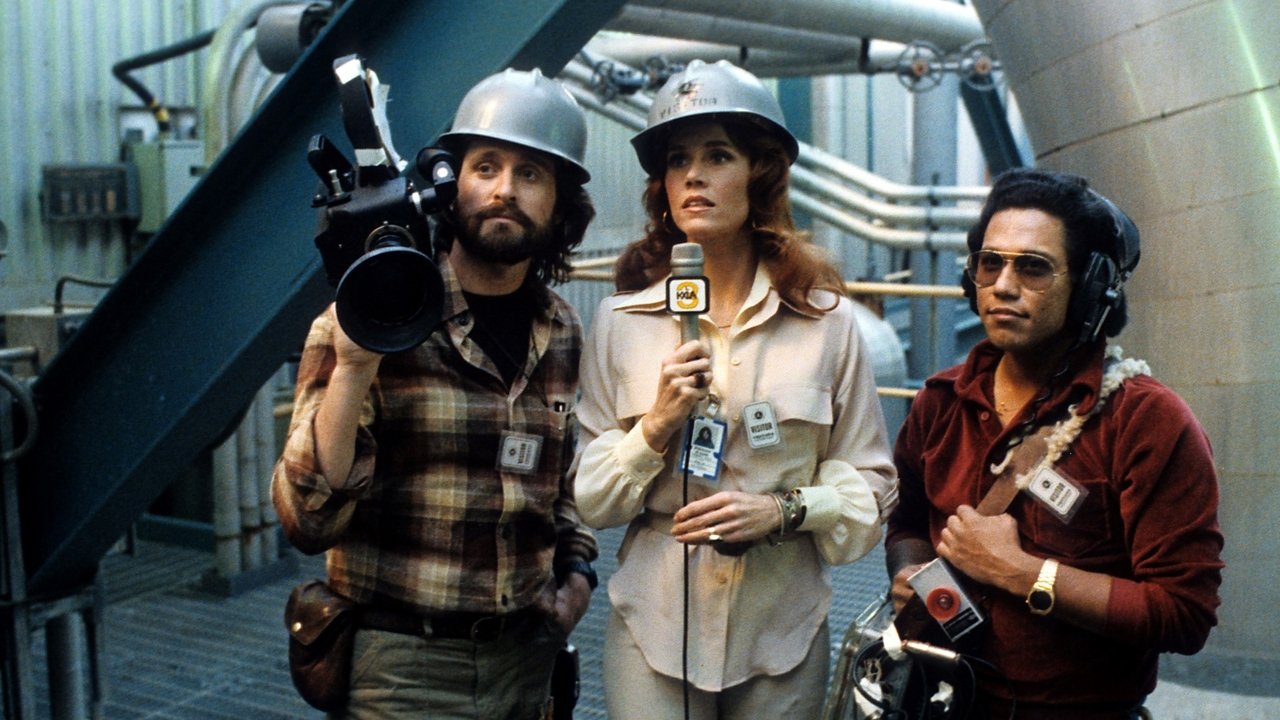
Kimberly Wells (Jane Fonda) and her cameraman Richard Adams (Michael Douglas) introduce the film's second register: the media as a system with its own distorting pressures. Wells is not free to report what she witnessed; her footage is held, her credibility is managed, her access is contingent on not pushing too hard. The film draws a precise distinction between journalism as craft — the pursuit of a verifiable account — and television news as institution, which has its own hierarchies, its own risk aversion, its own preference for stories that fit within the available two minutes. Adams, operating as an independent with a camera he shouldn't have used, is the only character in the film who is institutionally unencumbered, which is why he is the only one who can act. The asymmetry is pointed: freedom of movement and freedom of information are functions of organisational position.
For anyone directing digital products, The China Syndrome is a case study in what happens when the feedback loop between operational reality and decision-making authority is severed. Godell's instruments are telling the truth. The organisation's instruments — its reporting structures, its approval chains, its regulatory filings — are telling a different story. The plant is both safe and unsafe simultaneously, depending on which information system you consult. This is not a failure of technology but of the organisational design that determines what information travels where, to whom, and in what form. Released twelve days before Three Mile Island, the film had the misfortune of being immediately confirmed. But its analysis of how complex systems develop institutional immunity to their own failure signals remains precise and instructive.