Солярис
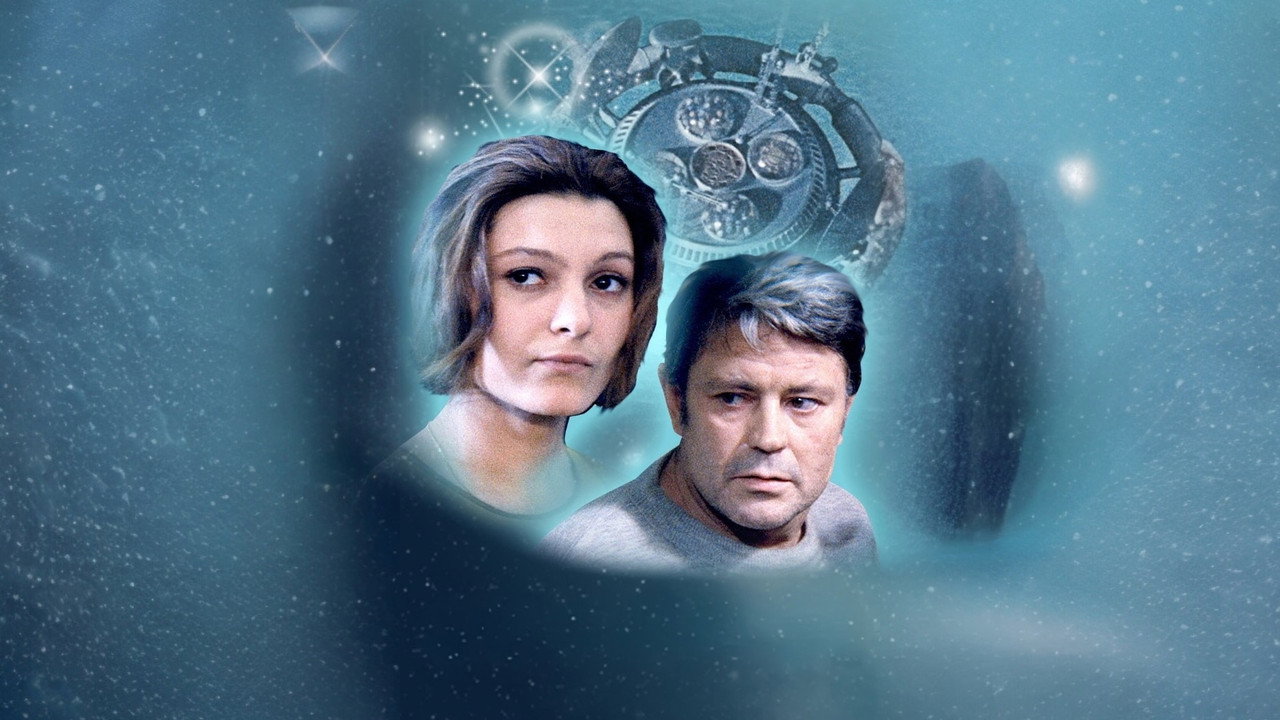
Writers: Fridrikh Gorenshtein (screenplay), Andrei Tarkovsky (screenplay)
Based on: "Solaris" by Stanislaw Lem (1961)
Cast: Donatas Banionis, Natalya Bondarchuk, Jüri Järvet, Vladislav Dvorzhetsky, Nikolai Grinko, Anatoliy Solonitsyn
Psychologist Kris Kelvin is sent to a research station orbiting Solaris, a planet whose entire surface is a single ocean that appears to be sentient. The station's scientific mission has collapsed: one researcher has committed suicide, and the two survivors are erratic, secretive, and hostile to any suggestion of continuing contact with the ocean. When Kelvin arrives, he discovers why. The ocean has begun producing physical copies of people from the cosmonauts' memories — in Kelvin's case, his wife Hari, who killed herself ten years earlier. The visitors are materially real, emotionally coherent, and impossible to explain within any framework the scientists possess. Whether the ocean is attempting communication, conducting an experiment, or doing something for which human categories do not apply is the question the film refuses to resolve.
The ocean on Solaris responds. That is the established scientific fact at the beginning of the film, and it is also the end of what anyone can say with confidence. An entire discipline, Solaristics, has been built around the ocean: libraries of observations, taxonomies of its surface formations, competing theories of its behaviour, a history of failed contact attempts. The field has produced more publications than results. It has named things it does not understand and used the names as evidence of understanding. And the ocean continues to do what it does, produce enormous, transient structures of staggering complexity that no theory can predict and no model can reproduce, indifferent to the frameworks that have been draped over it. Tarkovsky shoots the ocean's formations in lingering detail, not as spectacle but as epistemological provocation: here is something that is clearly organised, clearly responsive, and completely opaque to interpretation. The standard categories — intelligence, intention, communication — are available, and none of them fits. The ocean may be intelligent in a way that has no intersection with human intelligence. It may be communicating in a medium that humans cannot receive. It may be doing something for which no verb exists. Solaristics has spent decades trying to determine which, and the film's structural claim is that the question may be unanswerable not because the ocean is unknowable but because the categories themselves are the wrong instrument.
When the ocean produces Hari — Kelvin's dead wife, reconstituted from his memories, materially real and emotionally present — the scientists face a problem that defeats every protocol they have. Hari is not a hallucination; she can be touched, she bleeds when cut, she reconstitutes when destroyed. She is not the real Hari; she does not have independent memories, and she knows, eventually, that she is something other than what she appears to be. She is not a message; there is no content to decode, no instruction embedded in her presence. She is a response, but to what question? Kelvin did not ask for her. He did not think of her deliberately. The ocean reached into his unconscious and produced the thing it found there, and it produced it with a fidelity that is either compassionate or clinical or neither, and nobody on the station can determine which. This is the anatomy of a wicked problem rendered as narrative: a system that responds to your input but not in a way you can map to your input, that reflects you but not as a mirror, that produces something recognisable and yet entirely outside the framework in which recognition operates. Snaut's observation — where there are no human beings, there cannot be motives accessible to human beings — is the only honest position, and the film gives it to the most damaged character on the station because honesty and damage tend to arrive together.
Kelvin's trajectory is the film's most painful and most useful argument. He starts by trying to get rid of Hari — sending the first version away on a rocket, which solves nothing because the ocean simply produces another. Then he tries to love her, which is easier and worse, because what he is loving is a projection of his own guilt and memory, constructed by an alien intelligence for purposes he cannot access. He cannot determine whether his feelings for this Hari are love, narcissism, or a response engineered by the ocean to produce exactly this attachment. The ocean has put him in a position where the difference between authentic emotion and manufactured emotion is undecidable — not because the emotion is false but because the conditions under which it arose cannot be evaluated by the person experiencing them. This is Tarkovsky's version of the measurement problem, and it is more rigorous than most philosophical treatments: what does it mean to feel something real in an environment where the reality of the stimulus is controlled by an intelligence you cannot interrogate? Snaut says it plainly — we don't need other worlds; we need mirrors — and the cruelty of the sentence is that it is true in both directions. Humanity went to Solaris looking for contact with the alien and found only itself reflected back, and the reflection is so precise that it cannot be distinguished from the thing it was looking for.
The film ends with Kelvin on what appears to be Earth — his father's house, rain, the familiar landscape — but the camera pulls back and reveals that the house sits on an island within the Solaris ocean. Whether Kelvin has returned or whether the ocean has produced a final, total replica of home is left unresolved, and the ambiguity is structural, not decorative. The ocean has done what it does: responded to what it found in the person nearest to it, producing something that matches a need, in a way that cannot be categorised as kindness or cruelty or experiment or art. Tarkovsky understood — and this is why the film has become more relevant as the systems we build grow more responsive and less interpretable — that the hardest problem is not building something that responds to us. It is knowing what the response means when it arrives. Every sufficiently complex system eventually reaches a point where it produces outputs that satisfy us in ways we cannot evaluate, because the satisfaction itself was part of the output. The ocean is not a metaphor for artificial intelligence, or for organisational complexity, or for any particular technology. It is a metaphor for the possibility that the distinction may not exist.