The Truman Show
Writers: Andrew Niccol (written by)
Cast: Jim Carrey, Laura Linney, Ed Harris, Noah Emmerich, Natascha McElhone, Holland Taylor
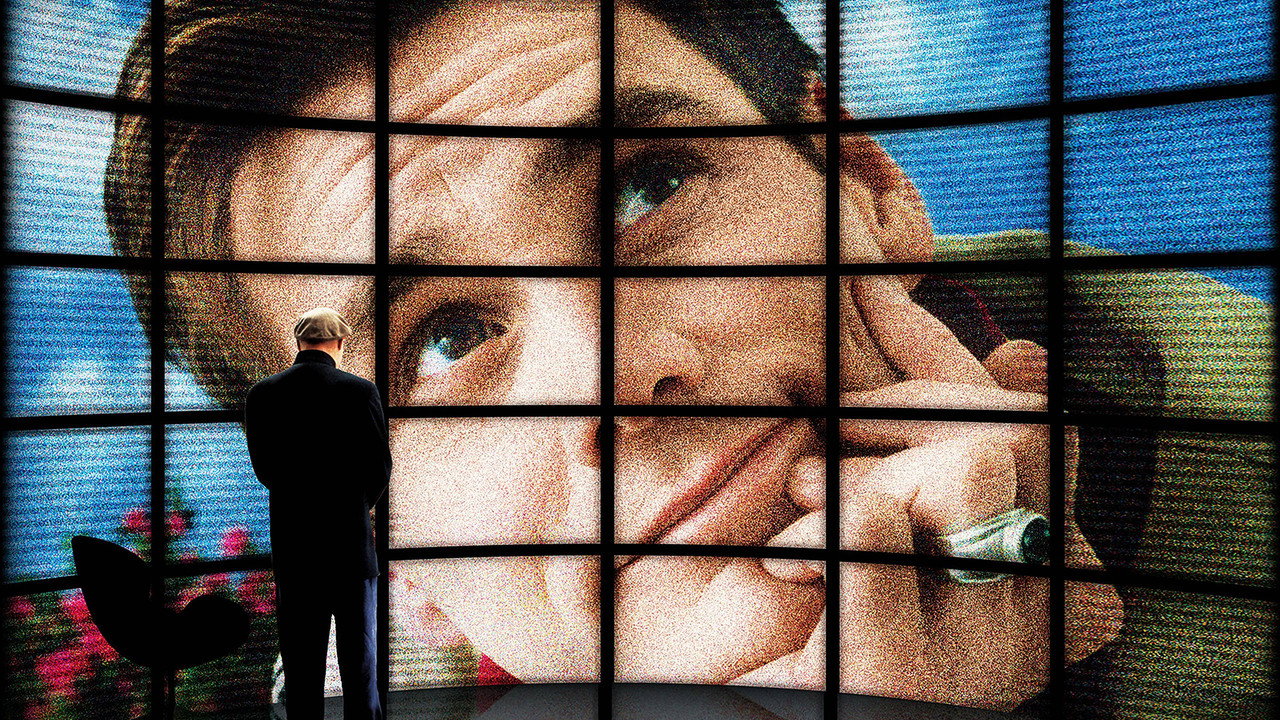
Truman Burbank, an insurance salesman in the coastal town of Seahaven, does not know that he was legally adopted by a television network at birth, that his town is a domed set, that his wife and best friend are contract actors, and that five thousand cameras have broadcast his life continuously for thirty years to an audience of more than a billion. The show's creator, Christof, directs from a control room in the artificial moon. As small failures accumulate — a studio light falling from the sky, a rain shower that follows only him, a radio channel narrating his movements — Truman begins to test the edges of the world he was given.
The Truman Show is the first film about a platform product, made a few years before anyone needed the word. The economics are stated plainly and are worth restating because they have become the default arrangement of the consumer internet: Truman's life is the content, the audience is the inventory, the advertisers are the revenue, and the operating requirement is that the person generating the content must not discover the terms of the deal. Everything in Seahaven follows from that requirement. The town is small because a small town can be instrumented. The ferry is broken because Truman must have reasons of his own for not leaving. Even his cheerful morning greeting to the street — a line he delivers to nobody in particular, in a voice pitched for an audience he does not know exists — is a piece of product behaviour that the show has cultivated in him and now depends on. He is not being watched while he lives. The watching is the shape his living has taken.
Christof is the most useful figure in the film precisely because he is not a villain in the way the premise invites. He is a product manager with a coherent thesis, a considerable talent, and a genuine belief that his work is a kindness. His defence — that the world outside is the sick place, and that he has given Truman a life protected from it — is not cynical, and it is not entirely wrong either, which is what makes it dangerous. Every closed system is sold on the same argument: we curate so you are not exposed, we constrain so you are not overwhelmed, the walls are a service. What Christof cannot see, and what nobody in the control room can raise with him, is that the value of a protected life cannot be assessed by the person doing the protecting. He has removed the only party with standing to judge the trade from the conversation about the trade, then cited their contentment as evidence.
His most quoted line is the one about accepting the reality of the world with which we are presented, and it is aimed at the audience rather than at Truman. This is the film's sharpest observation about how defaults actually work. Truman is not coerced, not drugged, not restrained. He is given a world with edges placed just beyond the range of ordinary curiosity, and ordinary curiosity is sufficient to keep him inside it for thirty years. Christof's other claim — that Truman could leave at any time if his determination were more than vague — is monstrous and also literally accurate, and the two facts do not cancel. That is the mechanism behind every dark pattern, every buried setting, every export function that technically exists. Consent extracted from someone who has never been shown the alternatives is not consent, but it looks identical to it from the inside of the control room, and it satisfies every metric the control room has.
The cost of the arrangement falls on the people who are neither the audience nor the product. Marlon, told to sit with Truman and steady him, delivers his promise never to lie while reading the line off an earpiece fed to him by Christof, and Noah Emmerich plays it as though he means every word — because in some part of himself he does. This is what complicity looks like inside a functioning organisation: not villainy, but a decent person performing a scripted intimacy, aware of the script, unable to stop. And it is why Christof's last words about Truman having been real, having been good to watch, land as an indictment of the whole apparatus rather than a tribute. Thirty years of total instrumentation and the only thing his system was ever able to measure was how watchable the man was. The one question a metric like that cannot ask is whether he wanted any of it.