Network
Writers: Paddy Chayefsky (written by)
Cast: Faye Dunaway, William Holden, Peter Finch, Robert Duvall, Ned Beatty, Beatrice Straight
Screenplay: Read screenplay ↗
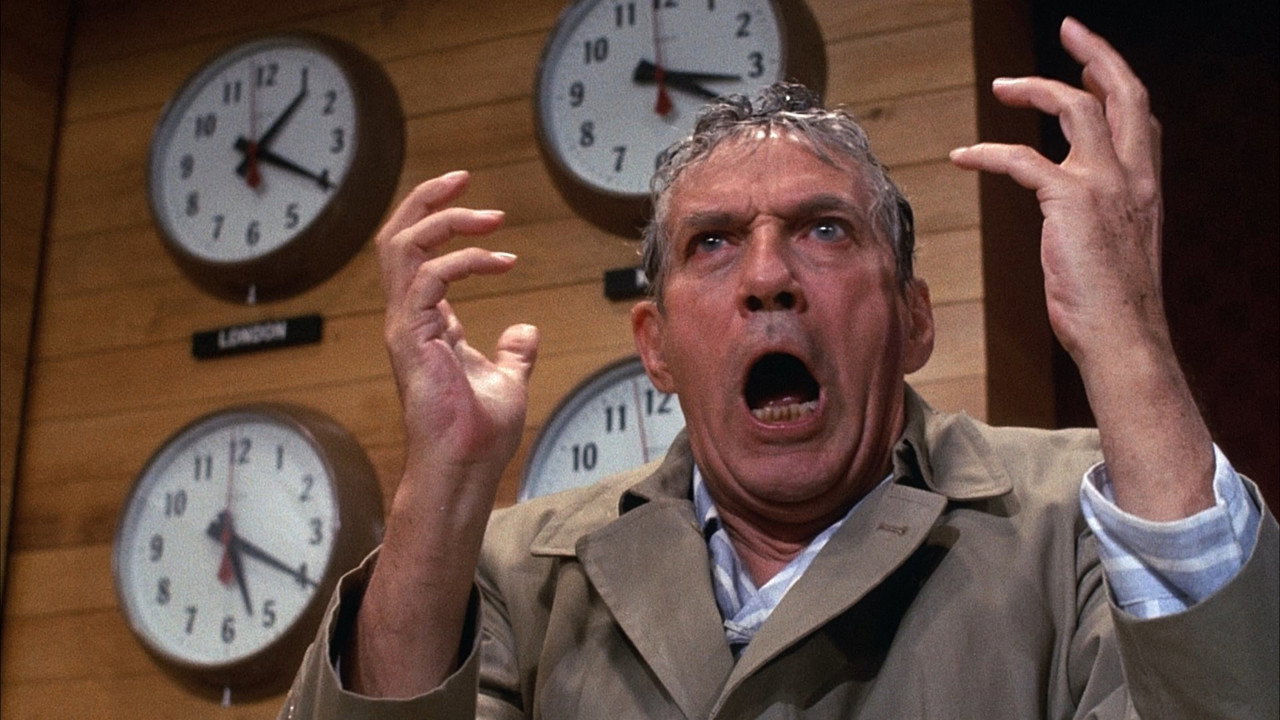
When veteran news anchor Howard Beale is fired for poor ratings and announces on air that he will kill himself the following week, the network discovers that his unravelling is the most watchable thing it has broadcast in years. Programming chief Diana Christensen turns his rage into a prime-time franchise, the news division is absorbed by entertainment, and the corporation that owns it all finds a use for a prophet who says exactly what the numbers reward.
Network opens with a firing and ends with an assassination, and everything in between is an experiment in measurement. Howard Beale is dismissed because his ratings have fallen; he announces on air that he will kill himself; the numbers move. That movement is the whole film. What Paddy Chayefsky understood in 1976 — decades before engagement metrics, algorithmic feeds or A/B tested outrage — is that rage is not merely one input among many to a ratings function. It is the most efficient one. It costs nothing to produce, it requires no craft, and it reliably makes people stay. Once a network notices this, the discovery cannot be un-noticed. What begins as an accident becomes a format, and what becomes a format becomes a strategy.
Diana Christensen may be the first pure product manager in cinema. She has no opinions about content. She reads the concept analysis report, sees that the American people want somebody to articulate their rage for them, and builds the product that serves the finding. Her genius is entirely a genius of optimisation, and her blindness is the specific blindness of anyone who has confused a proxy with the thing it stands for. She can see the share and the demographic split with perfect clarity. What she cannot see is what the share is doing to the people producing it, and she cannot see it because nothing in her instrumentation measures that. Max Schumacher's accusation — that she is television incarnate, indifferent to suffering, insensitive to joy — is not really a moral charge. It is a description of what happens to a person who has internalised a dashboard.
Then there is Arthur Jensen, and the scene where the film stops being satire about broadcasting and becomes something colder. Beale has attacked a corporate deal on air, and Jensen summons him not to fire him but to convert him. The world is a business, Mr. Beale. There are no nations, no peoples, only one holistic system of systems. The speech is delivered in a darkened boardroom, in the register of a sermon, and that register is the point: this is cosmology, not commerce. What makes the scene devastating is what happens next. The network does not want Beale angry anymore — anger has served its purpose, it moved the numbers, and now there is a new gospel that needs a preacher. Beale becomes the instrument of the very thing his rage was aimed at. This is the mechanism by which attention economies absorb their critics: not by silencing them, but by giving them a slot.
And the ending is not a tragedy in any conventional sense. It is arithmetic. Beale's ratings decline — the sermon does not sell as well as the rage did — and so the product is killed, in the most literal way available. Nobody in the room is cruel. Nobody hates Beale. The decision is made in the same tone as a decision to cancel a show, because that is exactly what it is. The system Chayefsky drew has no sentiment in it and no malice either; it has only a function to maximise, and a man whose contribution to that function has gone negative. Anyone who has watched a metric become a target, and then watched the target become the only thing anyone can see, will recognise the shape of the last scene. It is not a warning about television. It is a warning about what happens when a number is the only thing an organisation can perceive.