AKIRA
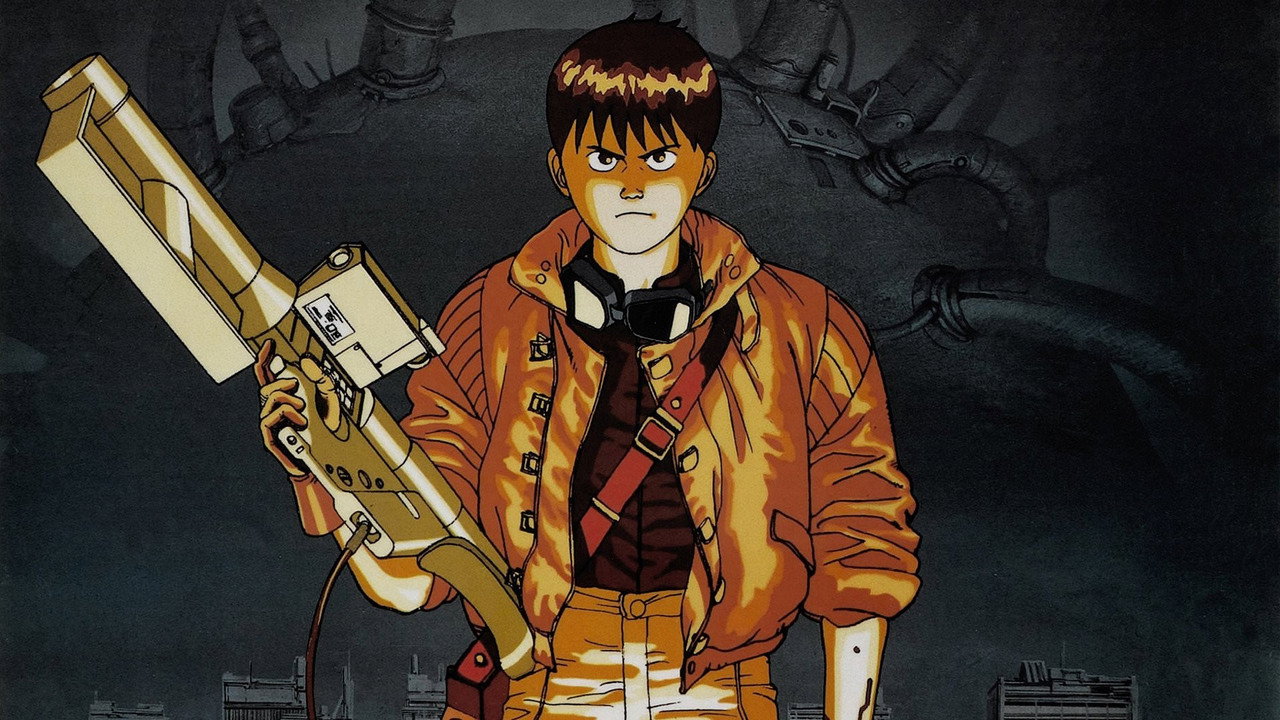
Writers: Katsuhiro Otomo (screenplay), Izo Hashimoto (screenplay)
Cast: Mitsuo Iwata, Nozomu Sasaki, Mami Koyama, Taro Ishida, Tessho Genda
In 2019, thirty-one years after a mysterious explosion destroyed Tokyo and triggered World War III, the rebuilt Neo-Tokyo is a city of gleaming towers and rotting foundations. Tetsuo Shima, a teenage biker, is exposed to a government programme that awakens psychic powers he cannot control. As his abilities grow beyond containment, the military, the resistance, and a council of ageing psychic children all converge on the same question: whether the force that destroyed the old city is about to destroy the new one — and whether anyone in a position of authority can do anything about it other than apply more force.
The opening image is an explosion — a white sphere expanding outward from the centre of Tokyo in 1988, swallowing the city in a single frame. The film never explains what the explosion was, and this is its first structural decision: explanations are a form of control, and the thing that destroyed Tokyo is defined by the failure of every attempt to explain it. What the government knows is that a child named Akira developed psychic abilities beyond measurement, and that those abilities did not stabilise, and that the result was the annihilation of the city and the start of a world war. What the government concludes from this is not that the programme that produced Akira should be abandoned but that it should be better managed. Thirty-one years later, in the rebuilt Neo-Tokyo — gleaming on the surface, corrupt and crumbling beneath — the military is still running experiments on psychic children, still pursuing the same capability, still believing that the problem was not the power itself but insufficient containment. The Colonel who oversees the programme is not a villain. He is a systems manager who has made the most dangerous error a systems manager can make: he has concluded that because the previous failure was a failure of control, the correct response is more control, without asking whether the system under management is the kind of system that admits of control at all.
Tetsuo Shima enters the programme by accident. He is a teenage biker, Kaneda's best friend and subordinate, a follower who has spent his whole life in someone else's wake and who resents it with the quiet, accumulating fury of anyone who knows he is defined by proximity to someone more capable. When a collision with an escaped psychic child activates dormant abilities in Tetsuo, the government captures him, studies him, and attempts to contain him. What follows is the most precise depiction of emergence in cinema: a force that grows exponentially, exceeds every threshold the institution sets, responds to suppression by accelerating, and transforms the host until the host can no longer be distinguished from the force. Tetsuo's body mutates, swelling beyond human form, consuming matter from its environment — machinery, cables, furniture, other bodies — in a grotesque expansion that is the film's visual argument about emergence: not a new capability added to an existing system, but the existing system being replaced by the capability, with no boundary left between organism and power. The military responds the way institutions always respond to forces they cannot model: with escalation. Larger weapons, tighter cordons, more soldiers. Each escalation fails, because the force does not operate at the scale the weapons are calibrated for, and each failure produces the next escalation. Institutions that cannot understand what they face will apply the tools they have, and the tools they have are force.
The three psychic children (Kiyoko, Takashi, and Masaru) are the film's most unsettling structural element, and they are unsettling because they understand what neither the military nor Tetsuo can. They are the survivors of the original programme, aged beyond their years, kept in a sealed facility, their powers stabilised through suppression. They know what Akira was because they were there, and what they know is that the power is not a weapon or a resource or a capability to be harnessed. It is a phase transition — a point at which a system crosses a threshold and becomes something categorically different from what it was, something that the old categories cannot contain because it has exceeded the domain in which the categories were defined. When Kiyoko says it has already begun, she is not issuing a warning in the conventional sense. She is describing a process that has passed the point of intervention — not because intervention is physically impossible, but because the intervenors do not have a model of the thing they would need to intervene in.
The Colonel's tragedy is that he is competent. He is decisive, disciplined, willing to sacrifice his career and his life to contain the threat. But competence is a function of the problem space you can see, and the problem space he can see is military — forces, positions, perimeters, escalation ladders. Tetsuo's power does not exist in that space. It exists in a space the Colonel has no instrumentation for, and his competence in the wrong space is more dangerous than incompetence would be, because it produces confident, well-executed actions that make the situation systematically worse.
The film ends with a second explosion — or rather, with a transformation that looks like an explosion from the outside but that the children recognise as something else. Tetsuo's power reaches its terminal phase, Akira's preserved remains are released, and Neo-Tokyo is destroyed in the same white sphere that opened the film. The city has been rebuilt and destroyed by the same force, and the institution that managed the force has been destroyed with it, and the only survivors who understand what happened are the children who were never consulted. Otomo's structural argument is complete: the system that produced the catastrophe rebuilt itself after the catastrophe, reproduced the conditions that caused the catastrophe, and then experienced the catastrophe again, not because it failed to learn but because learning would have required abandoning the framework within which the institution understood itself, and no institution will do that voluntarily. The programme continued because the programme was the institution's identity: to abandon it would be to admit that the institution's core capability — the management of forces — did not apply to this force, and that admission would dissolve the institution's reason for existing. The children who understood what was happening watched from their sealed room, already knowing the outcome, because they had seen it before, and because the institution that held them had never once asked them what they knew.