Logan's Run
Writers: David Zelag Goodman (screenplay), William F. Nolan (novel), George Clayton Johnson (novel)
Cast: Michael York, Jenny Agutter, Richard Jordan, Roscoe Lee Browne, Farrah Fawcett, Peter Ustinov
In a sealed domed city of the twenty-third century, society has eliminated aging, overcrowding, and scarcity by killing everyone at thirty. Citizens live in frictionless pleasure until their Lastday, when they enter Carousel — a public ritual that promises renewal but delivers death. Logan 5, a Sandman who enforces the rule by hunting runners, is assigned to find Sanctuary, the rumoured escape route. To do so he must become the thing he has spent his career destroying: a runner. What he discovers outside the dome is not a resistance but a ruin, and what he brings back is not revolution but evidence — of age, of sky, of a world the system told him did not exist.
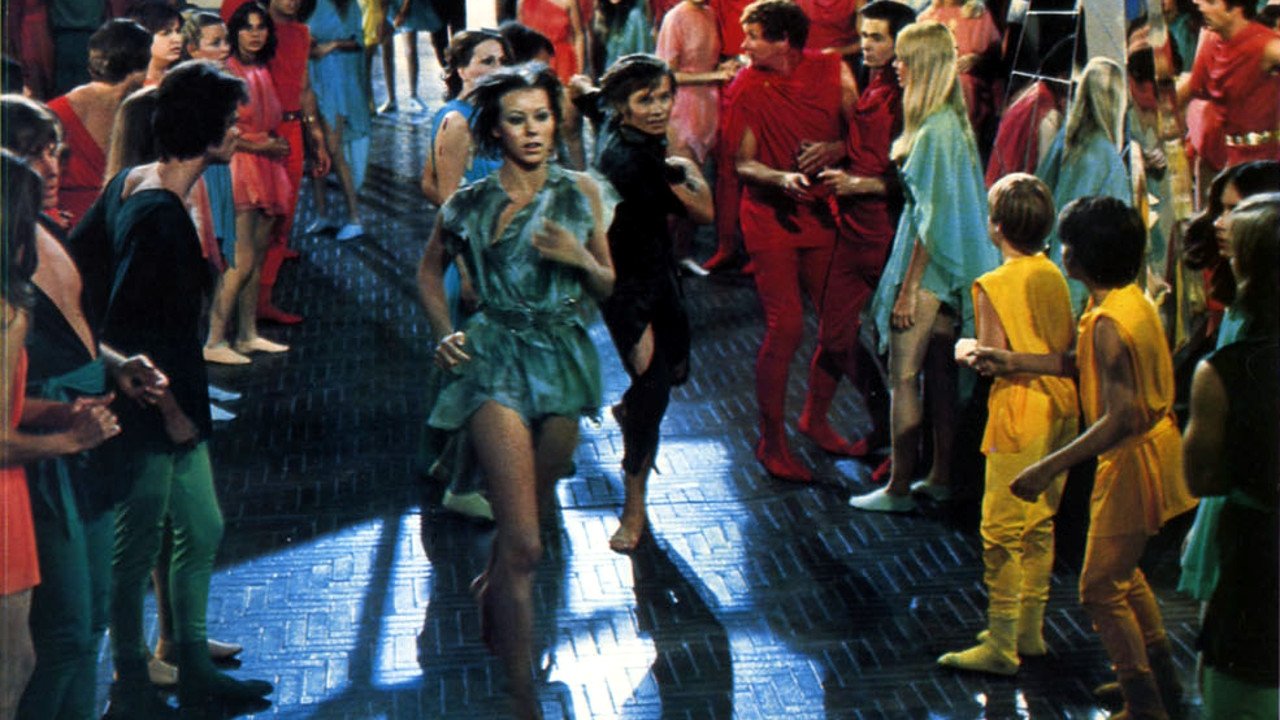
The city works. That is the first thing the film establishes and the thing it never lets you forget. Nobody in the domed city of 2274 is hungry, cold, lonely, or bored. Pleasure is universally available and friction has been engineered out of every social interaction. The architecture is clean and curved and lit from within; the transit system moves people without delay; the population is young, healthy, and beautiful, because everyone who would be old, sick, or plain is dead. They die at thirty, in a public ceremony called Carousel, where citizens float upward into a bright light while the crowd chants for renewal. Nobody is renewed. The ceremony exists to make the population watch the system perform its central function — termination — and to interpret the performance as regeneration, which they do, because nobody alive has ever seen a body age. The system's logic is airtight: limited resources, sealed environment, fixed carrying capacity, therefore fixed lifespan. The conclusion follows from the premises. Every engineer would recognise the elegance. And the film's entire argument is that the elegance is the problem, because a system elegant enough to answer every question within its frame eventually makes the frame invisible, and its inhabitants cannot ask whether the premises still hold, because they cannot see that there are premises.
Logan 5 is a Sandman — the enforcement layer. He chases runners, citizens who refuse to report for Carousel, and he kills them. He does this without malice and without doubt, because within the system's logic a runner is not a person exercising a preference; a runner is a defect, a unit that has failed to complete its lifecycle, and termination is not punishment but maintenance. The film is specific about Logan's psychology: he is not a zealot. He is a functionary who has never had a reason to question the function.
When the city's central computer assigns him to find Sanctuary — the rumoured destination of runners who escape — it does something that the system cannot account for: it removes four years from his lifeclock, moving him from green to red, from observer to subject. The computer does this, presumably, to give him cover as a runner, but the film leaves open the possibility that the computer does not understand what it has done, because the computer operates in the same frame as everyone else. It can model enforcement. It can model logistics. What it cannot model is what happens when someone inside the system is given a reason to see the frame, because seeing the frame is not a system function. Logan begins to run, and what makes his running consequential is not courage — it is the experience of discovering that the question he was trained not to ask has an answer, and the answer is outside.
Outside is the film's strangest and most precise image. The world beyond the dome is not a wasteland. It is Washington, D.C., overgrown with vines, inhabited by cats and one old man (Peter Ustinov, in a performance of bewildered gentleness) who lives among the ruins of the Senate and has never seen anyone younger than himself. He is the only old person Logan and Jessica have ever encountered, and they do not know what age is. They touch his face, astonished by the lines, and what they are touching is evidence that the operating assumption of their entire civilisation — that humans cannot live past thirty — is false. Not ideologically false, not morally false, but empirically false: here is a body that did not die, and the dome's system has no representation for it. This is the film's structural claim. The dome did not suppress the knowledge that people can grow old; it created conditions under which the knowledge was never generated, because everyone who might have generated it was killed before they could. The system did not lie about age. It prevented age from occurring and then operated as though the absence of age were a law of nature rather than a policy. Every organisation that has ever eliminated the department that measured the problem it wanted to forget has performed the same operation at smaller scale.
Box is the figure that makes the mechanism explicit, and the film places him at the midpoint for structural reasons. Box is an automated system in the ice caverns between the city and the outside. His function was to freeze and store food — fish, and plankton, and sea greens, and protein from the sea, he recites, with the mechanical cheerfulness of a tour guide. At some point the sea life stopped arriving and runners started arriving instead, and Box began freezing the runners, because Box has an input function (receive what arrives) and a processing function (freeze and store it) and no function that distinguishes one kind of input from another. He is not evil. He is not broken. He is performing exactly the task he was designed for, applied to an input his designers did not anticipate.
His gallery of frozen runners is the most disturbing image in the film, and it is disturbing precisely because there is no malice in it — there is only a process that continued after its context changed, operating faithfully on assumptions that no longer hold, and no one left to notice that the assumptions have shifted. When Logan destroys Box, he is not overcoming a villain. He is terminating a process. The process could have been terminated at any time by anyone who noticed the discrepancy, but nobody did, because the only people who reached Box were runners, and runners were, by the dome's definition, already defective, and defective units do not generate valid reports. The system's immunity to correction was built into its classification of who was allowed to report a problem.