RoboCop
Writers: Edward Neumeier (screenplay), Michael Miner (screenplay)
Cast: Peter Weller, Nancy Allen, Dan O'Herlihy, Ronny Cox, Kurtwood Smith, Miguel Ferrer
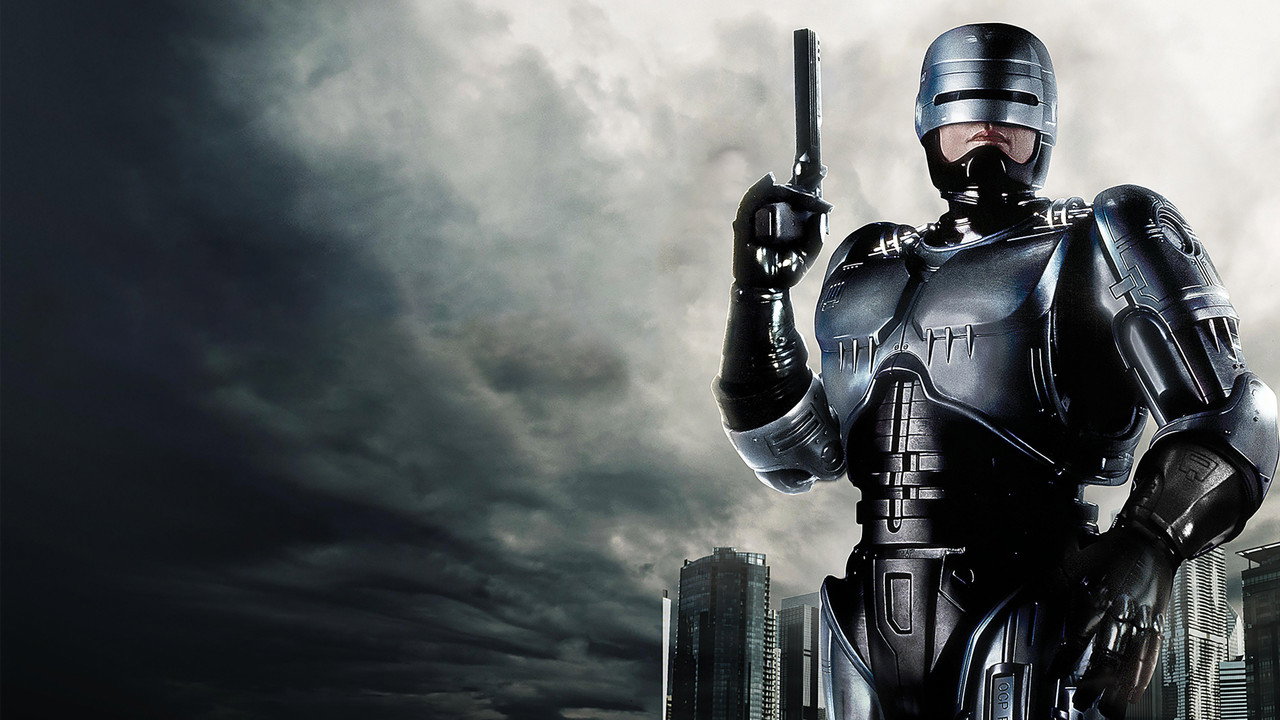
In a near-future Detroit hollowed out by crime and fiscal collapse, the mega-corporation OCP wins the contract to run the police department and begins building a product line for law enforcement. After its fully autonomous robot, ED-209, kills a junior executive during a boardroom demonstration, the company falls back on a cheaper option: RoboCop, a cyborg built from the remains of a murdered officer named Alex Murphy. Murphy's body is the hardware; OCP's directives are the software. The product works, and then the product starts remembering who it used to be.
The boardroom scene tells you everything the film is about, and it happens before the title character exists. Omni Consumer Products is demonstrating ED-209, a fully autonomous enforcement unit, to its senior leadership. A junior executive is asked to hold a gun and threaten the machine so it can demonstrate its disarming protocol. ED-209 barks a compliance warning, the executive drops the gun, and the machine fires anyway, shredding him across the conference table in a sustained burst while executives dive for cover. The Old Man, the chairman, turns to Dick Jones and says only that he is very disappointed. Jones, who oversaw the programme, is not fired, not investigated; the response is organisational embarrassment at a product that did not demo well. Later, Jones explains his position cleanly: he had a guaranteed military sale, a renovation programme, spare parts for twenty-five years — who cares if it worked or not? The line is the purest articulation of platform economics in 1980s cinema. The product is not law enforcement. The product is the contract, and the contract pays whether the product works or not. ED-209 does not need to reduce crime. It needs to be purchased, deployed, and maintained, and those three verbs generate revenue independently of any outcome on the street. A man is dead in the boardroom and the only operational consequence is that a competing project gets funded instead.
That competing project is RoboCop, and its creator, Bob Morton, is a young executive with exactly the ambition the corporation rewards. His pitch is that they practically gutted the body and rebuilt it from scratch, but they managed to save the left arm. The line is delivered as a boast — they saved the arm, meaning they were so resourceful that they found a use for part of the raw material. Nobody in the room pauses on the fact that the raw material is a police officer named Alex Murphy who was shot to pieces in the line of duty while OCP's own police force was too under-resourced to back him up. Murphy's murder is not an accident that the programme exploits; the programme requires a dead officer, and OCP's contract ensures that dead officers are plentiful. The organisational design creates the supply for its own input. Morton does not think of himself as complicit in Murphy's death because there is no line item in the project plan that says "acquire corpse"; the corpse is a resource allocation handled by another department, which is to say by the conditions the company created and chose not to improve. This is how large organisations distribute moral weight until it disappears: no single role carries enough of the picture to feel responsible, and the picture is visible only from a height where responsibility has been replaced by quarterly performance.
RoboCop's operational directives are the film's sharpest joke, and like all of Verhoeven's jokes, they work because they are structurally exact. The product ships with three: serve the public trust, protect the innocent, uphold the law. These are noble directives and they are also completely generic — they could be printed on a municipal brochure, a police car, a campaign poster. They provide no guidance on trade-offs, no ranking, no instruction for what to do when serving the public trust means not upholding a law, or when protecting the innocent requires violating the chain of command. They are a mission statement, not a decision framework, and they are enforced by firmware, which means Murphy cannot override them even when they are inadequate.
But the fourth directive is the one that matters. Directive Four is classified: RoboCop cannot act against any senior OCP officer. It is the one directive that is specific, operational, and binding, and it exists not to make the product effective but to make the product safe — safe for the company that owns it. The product can enforce the law on anyone except the people who are most positioned to break it at scale. The architecture of control is oriented inward, toward protecting the organisation, and outward enforcement is the marketing skin stretched over that architecture. Anyone who has read a terms-of-service agreement knows the structure: the public-facing language is expansive and aspirational; the operative clause is the one you have to look for, and it protects the platform.
The television interludes are not comic relief. They are the operating environment. Between every scene of violence, Verhoeven cuts to advertisements and news broadcasts played at a pitch of cheerful banality — a family board game about nuclear war, a commercial car with impossibly bad fuel economy, a catchphrase comedian repeating "I'd buy that for a dollar" to roaring laughter. The media does not comment on what is happening in Detroit. It runs parallel to it, filling the same airspace with a different signal, and the audience inside the film watches both feeds with the same level of attention, which is none. This is the economy of attention as anaesthesia: the population is not oppressed into silence, it is entertained past the point of noticing. OCP does not need to suppress information about what it does; it only needs the information to be one signal among many, at the same volume, in the same tone, and the signal loses its capacity to produce a response.
When Murphy, at the very end of the film, is asked his name and answers "Murphy" instead of his product designation, the moment works because it is the first time in the film that a piece of information has been received as meaning rather than noise. He is not reclaiming his humanity in some abstract sense. He is refusing the product label and insisting on the identifier that connects him to a history the corporation tried to overwrite. The system built him to serve. It did not anticipate that the material it built him from might remember what it meant to choose.