Soylent Green
Writers: Stanley R. Greenberg (screenplay), Harry Harrison (based on the novel "Make Room! Make Room!")
Cast: Charlton Heston, Edward G. Robinson, Leigh Taylor-Young, Chuck Connors, Joseph Cotten
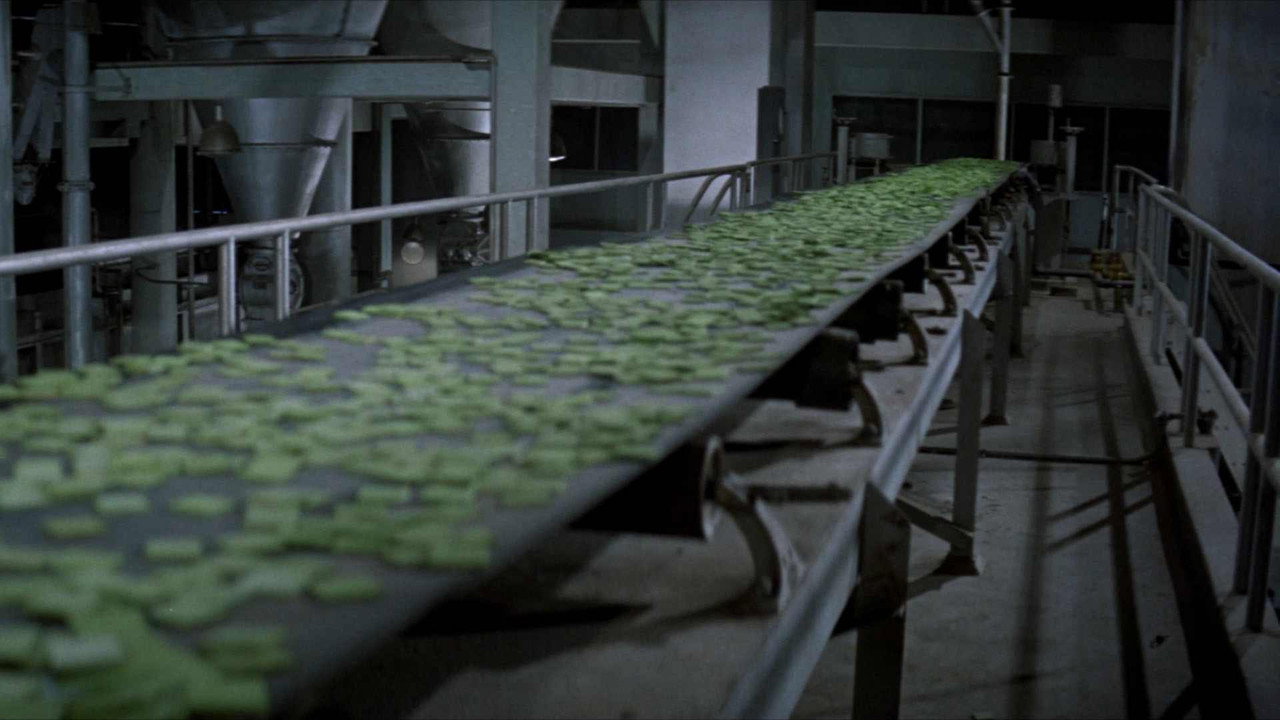
New York, 2022. Forty million people are packed into the city and the natural food supply has collapsed. The population survives on processed wafers manufactured by the Soylent Corporation, the latest product being Soylent Green, said to be made from ocean plankton. When a senior Soylent executive is murdered, Detective Thorn investigates and discovers what the product is actually made from. The discovery changes nothing, because the system that produces it is the only system that feeds anyone.
The film's most famous line is its least interesting element. Everyone knows the reveal — Soylent Green is made out of people — and the sentence has entered the language as shorthand for a terrible secret, but the secret is not where the film's intelligence lives. The intelligence lives in what comes after the reveal, which is nothing. Detective Thorn screams the truth into a crowd being loaded onto trucks, and the crowd does not stop, and the trucks do not stop, and the factory does not stop. The system hears the information and cannot metabolise it, because metabolising it would mean confronting a question the system has no capacity to answer: if you shut down the food supply, what do you feed people instead? The reveal is not a twist that resolves the plot. It is a diagnosis that the plot cannot absorb, and the impossibility of absorption is the actual subject of the film. The Soylent Corporation is not hiding a crime in the ordinary sense. It is operating a logistics chain in which the input and the output are the same population, and the chain is the only chain, and the chain is feeding forty million people who have no alternative. The moral horror and the operational dependency are fused. You cannot separate the atrocity from the service.
Sol Roth is the only character who registers the reveal as loss rather than as information, and the distinction matters. Sol is old enough to remember food — real food, the taste of strawberries, the existence of lettuce. He carries in his body the memory of a different system, one that drew its inputs from soil and sunlight and rain, and when he discovers what the current system draws its inputs from, he has a reference point against which to measure the distance. Thorn does not. Thorn has never known anything except the present arrangement. When Sol tries to tell him that people were better, that the world was better, Thorn cuts him off — he has heard it a hundred times. The generational divide is not sentimental; it is epistemic. Sol can identify the system as monstrous because he has a model of a non-monstrous alternative. Thorn can identify the murder of a Soylent executive as a crime worth investigating but cannot identify the Soylent system as a crime worth stopping, because the system is the ground he stands on. You cannot perceive as broken a thing you have never seen whole, and this is why the people most embedded in any system are the last to recognise its dysfunction: they have no contrast image.
Sol's response to the knowledge is to go to the government euthanasia centre, which the film stages with heartbreaking care — they play him Beethoven and show him projections of forests and rivers and deer, things that no longer exist, and he watches them as a man watches home movies of someone who has died. He is not choosing death over life. He is choosing to stop participating in a system whose logical endpoint he now understands, and his death is the only form of refusal the system permits, because the system has a procedure for death. It does not have a procedure for dissent.
The Soylent Corporation is the most realistic corporate villain in 1970s science fiction because it is not evil in any way that an organisation chart would reveal. There is no scene in which an executive cackles over the production process. The murder that opens the film is committed not to protect a secret for its own sake but to prevent the disruption of a supply chain that millions depend on. The people who run the corporation understand what they are doing — the murdered executive was preparing to confess, which means his conscience could not carry it — but they also understand that the alternative to what they are doing is famine, and famine at a scale that makes the current arrangement look merciful by comparison. The film refuses to let the audience resolve this tension. It shows a system that arose incrementally — overpopulation, climate collapse, ocean death, food shortage, each step making the next step rational — and asks you to identify the point at which the system became unacceptable, knowing that no single step was the one where the line was crossed. How did we come to this, Sol asks, and the answer is that nobody came to this. Everybody took one step, and this is where all the steps arrived.