La battaglia di Algeri
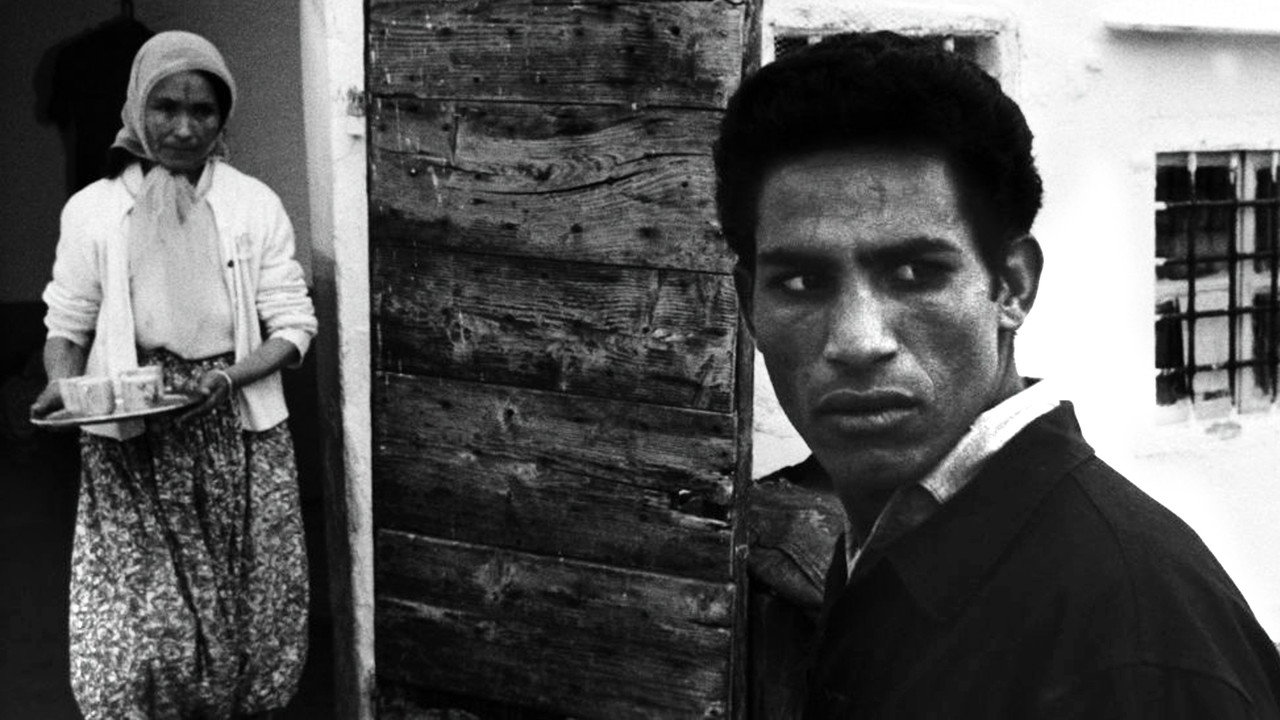
Writers: Franco Solinas (screenplay), Gillo Pontecorvo (screenplay)
Cast: Brahim Hadjadj, Jean Martin, Yacef Saadi, Samia Kerbash, Tommaso Neri
Algiers, 1954-1957. The National Liberation Front begins an urban insurgency against French colonial rule, organising the Casbah into a network of cells whose members know only their immediate contacts. Colonel Mathieu, a French paratrooper commander, arrives with a mandate to destroy the network and the analytical tools to do it: he maps the FLN's cell structure on a chalkboard, identifies its nodes, and eliminates them one by one through interrogation and targeted raids. He succeeds. Every leader is captured or killed, and the insurgency collapses. Two years later, without organisation, without leaders, without a structure for the French to map, the Algerian population rises spontaneously and the revolution succeeds.
The chalkboard scene is the one the Pentagon screened. Colonel Mathieu stands before his officers and draws a pyramid. At the top is the FLN's military command. Below it, zone leaders. Below them, sector leaders. Below them, cell leaders. Below them, the cells themselves — groups of three, each member knowing only the other two and the identity of the person who recruited them. The structure is textbook clandestine organisation: compartmentalised, redundant at the bottom, vulnerable at the top. Mathieu explains that if you work upward from any captured cell member, applying sufficient interrogation, you will eventually reach the name above, and from that name the name above that, and the process terminates at the top of the pyramid, at which point the network is destroyed.
He is correct. His analysis is methodologically sound, operationally precise, and the film shows it working exactly as described. Cell members are captured, interrogated, broken. They give up names. Paratroopers raid safe houses, find documents, make more arrests. The network contracts. Ali la Pointe, the last surviving leader, is cornered in a hidden room behind a wall in the Casbah. A charge is set. The wall comes down. The battle of Algiers is over, and the French have won it. Pontecorvo films this with the grammar of a documentary — handheld cameras, no score during the raids, faces that look like faces rather than performances — because the fact that Mathieu is right is not the argument the film makes. The argument the film makes is that being right about the structure of the network tells you nothing about the nature of the movement the network was built to carry.
The distinction matters, and it is the distinction that most organisational analysis misses. A network is a structure: nodes, edges, communication protocols, hierarchy. A movement is something else. A movement is the condition that made the network necessary — the grievance, the shared understanding, the accumulated weight of experience that, at some point, crossed a threshold and began to organise itself. Mathieu can see the network because the network has a shape that intelligence methods can detect. He cannot see the movement because the movement does not have a shape; it has a temperature. When he destroys the network, he does not lower the temperature. He removes the thermostat. The FLN's cell structure was not the insurgency; it was the insurgency's management layer, the organisational technology that converted diffuse anger into coordinated action. Destroying the management layer does not destroy the anger. It destroys the channel through which the anger was being expressed in a form that could be mapped, targeted, and defeated. What replaces it is something worse, from Mathieu's perspective: spontaneous, unstructured, unmappable mass action. Two years after the battle is won, the population of Algiers pours into the streets. There are no cells. There are no leaders. There is no chalkboard diagram that will help, because there is nothing to diagram. The system has reorganised itself at a lower level of structure and a higher level of participation, and the French, who understood the organisation perfectly, have no instrument for engaging with a crowd.
Ben M'Hidi, captured midway through the film, gives the line that compresses the entire argument into a single exchange. Journalists ask him whether it is cowardly to use women to carry bombs in shopping baskets. Give us your bombers, he says, and you can have our baskets. The line is not a justification of terrorism. It is a statement about resource asymmetry and organisational constraint. The FLN does not use women with baskets because it prefers the method; it uses them because it does not have an air force. Every organisational decision in the film is a decision shaped by constraint, and the film's refusal to romanticise either side is what makes it so durable as a study of how organisations actually work under pressure. The French have overwhelming material superiority, professional soldiers, intelligence infrastructure, and a legal framework that allows them to do whatever they decide is necessary. The FLN has the Casbah, local knowledge, popular support, and an organisational structure designed to survive the loss of any individual node. Both sides are making the best decisions available to them given their constraints, and the outcome is determined not by who makes fewer mistakes but by which constraints are harder to overcome. Mathieu can destroy the network. He cannot destroy the conditions that produced it. The FLN cannot defeat the paratroopers. It does not need to. It needs to outlast the political will that sent them.
This is why the film was screened at the Pentagon in 2003, during the early phase of the Iraq occupation, and it is also why screening it changed nothing. The lesson is legible. It is even simple. But it requires something that military and organisational hierarchies are structurally unable to provide: the willingness to accept that your analytical framework, however correct, is operating on the wrong layer of the system.
Mathieu knows this. He is the most honest character in the film precisely because he never pretends that his methods will produce a lasting outcome. Should France remain in Algeria? he asks the politicians. If you answer yes, you must accept all the necessary consequences. The consequences he means are torture, collective punishment, the systematic destruction of civil liberties — the operational requirements of maintaining control over a population that does not consent to be controlled. He is not advocating for these things. He is describing the cost structure and noting that the decision to pay it was made somewhere above his rank. His operations are tactically impeccable and strategically irrelevant, and he knows it, and he does them anyway, because the institution he serves has no mechanism for integrating his strategic assessment into its tactical directives. The chalkboard is perfect. The pyramid is accurate. The network is destroyed. And two years later the streets fill with people who were never on the chalkboard, because they were never nodes in a network. They were the sea the network swam in, and the sea does not have a topology.