The Iron Giant
Writers: Tim McCanlies (screenplay), Brad Bird (screenplay)
Based on: "The Iron Man" by Ted Hughes (1968) ↗
Cast: Vin Diesel, Jennifer Aniston, Harry Connick Jr., Eli Marienthal, Christopher McDonald, John Mahoney
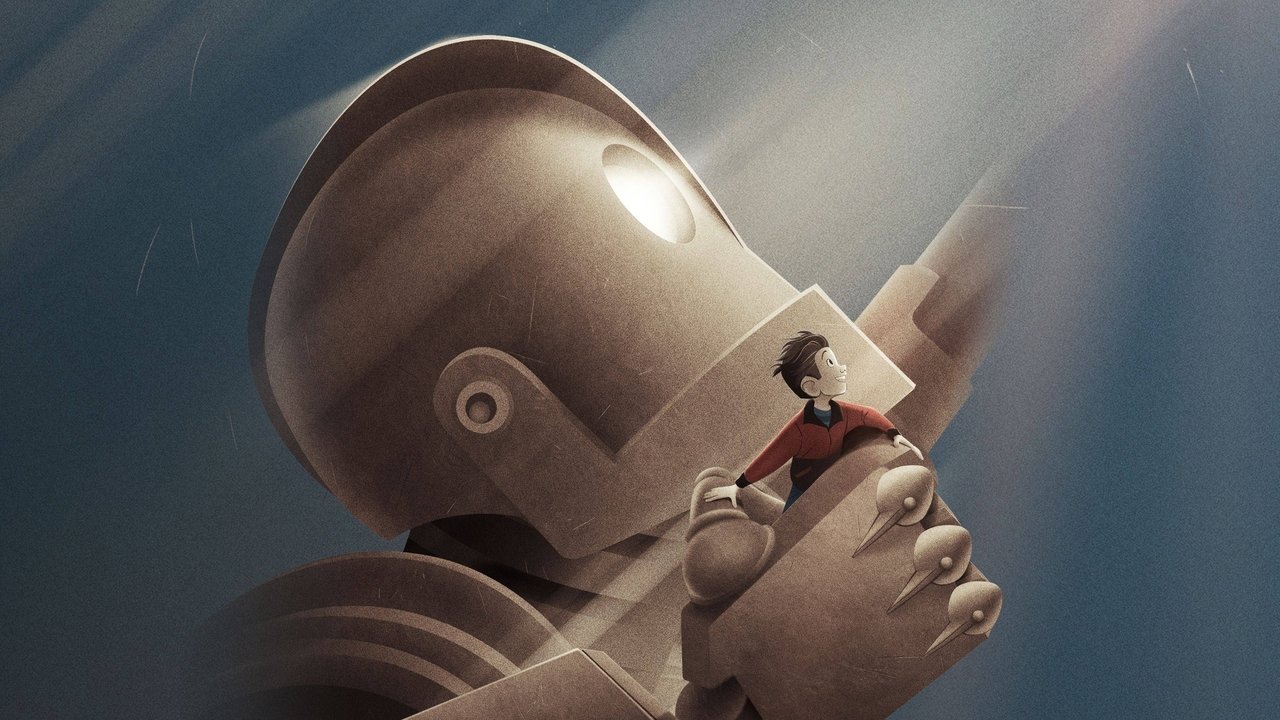
In 1957, a giant metal robot crashes from space into the ocean near a small town in Maine. Hogarth Hughes, a nine-year-old boy, finds the Giant eating metal at a power station and befriends it. The Giant has no memory of where it came from or why it was built, but when threatened it activates defensive weapons systems of enormous destructive power — systems it does not consciously control. A federal agent named Kent Mansley discovers the Giant and calls in the military. In the climax, the Giant must choose between what it was built to do and what it has learned to be.
The Iron Giant does not know what it is. This is the film's first and most important structural choice: the robot arrives damaged, its memory erased, its purpose unavailable to itself. It does not know where it came from, who built it, or why. It knows how to eat metal, how to repair itself, how to walk — the operational layer is intact. The strategic layer, the layer that would tell it what it is for, is gone. And in that absence, in the gap between capability and purpose, the film stages its entire argument. Because the Giant is, by engineering, a weapon. When it is frightened or threatened, systems activate that it does not choose to activate: its eyes change, targeting systems deploy, energy weapons of extraordinary power emerge from its body and operate with precision the Giant does not direct. The weapon is the specification. The weapon is what somebody, somewhere, designed and built and sent across space. And the Giant — the consciousness that sits inside the weapon — does not want to be what it was designed to be. I am not a gun. It is the simplest possible sentence about the relationship between specification and identity, and it carries a claim that no engineering discipline has ever been fully comfortable with: that a system's purpose is not determined solely by the intention of its builder, and that what a thing was built to do and what it is are not necessarily the same question.
Hogarth teaches the Giant by reading to it, and the text he chooses is Superman. This is not a throwaway reference; it is the film's philosophical mechanism. Superman is, like the Giant, an alien being of enormous destructive power who chooses not to destroy. He could. The capability is there. The choice not to use it is what makes him Superman rather than a threat. Hogarth explains the framework to the Giant in the only terms a nine-year-old can muster, and they turn out to be the right terms: You are who you choose to be. This is an assertion about identity that runs counter to every deterministic model — biological, mechanical, computational — that has ever tried to derive what something is from what it is made of or what it was made for. The weapons fire. They are devastating. They are part of the Giant in the same way that the capacity for violence is part of any sufficiently powerful entity. And what the Giant does with them is the thing we have no better word for than identity.
Kent Mansley is the film's institutional voice, and Brad Bird gives him one line that functions as an epistemology. All I know is we didn't build it, and that's reason enough to assume the worst and blow it to kingdom come. This is not stupidity, and the film does not play it as such — it plays it as a policy position, which is worse, because policy positions survive the individuals who hold them. Mansley's reasoning is: unknown origin, unknown capability, therefore maximum threat, therefore maximum response. In 1957, with Sputnik in the sky and nuclear drills in every school, this is not an unreasonable framework. It is, in fact, the framework that the entire Cold War defence apparatus was built on: what we do not understand, we must assume is hostile, because the cost of being wrong in the other direction is annihilation.
The problem is that the framework has no mechanism for updating. It cannot accommodate new information — that the Giant eats metal rather than people, that it plays with a child, that it saves lives — because the framework's prior is so strong that no amount of evidence can overcome it. Mansley's certainty increases as his evidence of threat decreases, because in his model, the absence of hostile action proves concealment, and concealment proves hostile intent. The film is staging a closed epistemic loop: a model that interprets confirming evidence as confirmation and disconfirming evidence as deeper confirmation, and that can therefore never be wrong, which means it can never be right, because a model that cannot be falsified contains no information about the world.
The Giant's final choice is the film's thesis, and it is staged with the precision it deserves. A nuclear missile is in the air, launched by Mansley in panic, aimed at the town. The Giant flies up to intercept it. As it rises, it remembers Hogarth's words — you are who you choose to be — and says a single word: Superman. And then it makes contact with the warhead and detonates. The weapon destroys itself to save the people it was designed — by someone, somewhere, for reasons it will never know — to destroy. Brad Bird is making a claim here that is either sentimental or profound, depending on how seriously you take it, and the film earns the right to have it taken seriously because it has spent its entire runtime establishing the conditions. The Giant is a weapon. The Giant is also a person. These are not contradictory statements; they are two descriptions of the same entity at different levels of abstraction, and the film's argument is that the higher level is the one that matters: the one where choice operates, where identity is constructed rather than inherited, where a system decides what it is rather than executing what it was told to be. I am not a gun is not a statement about hardware. It is a statement about the right of any sufficiently complex system to refuse its own specification.