The Matrix
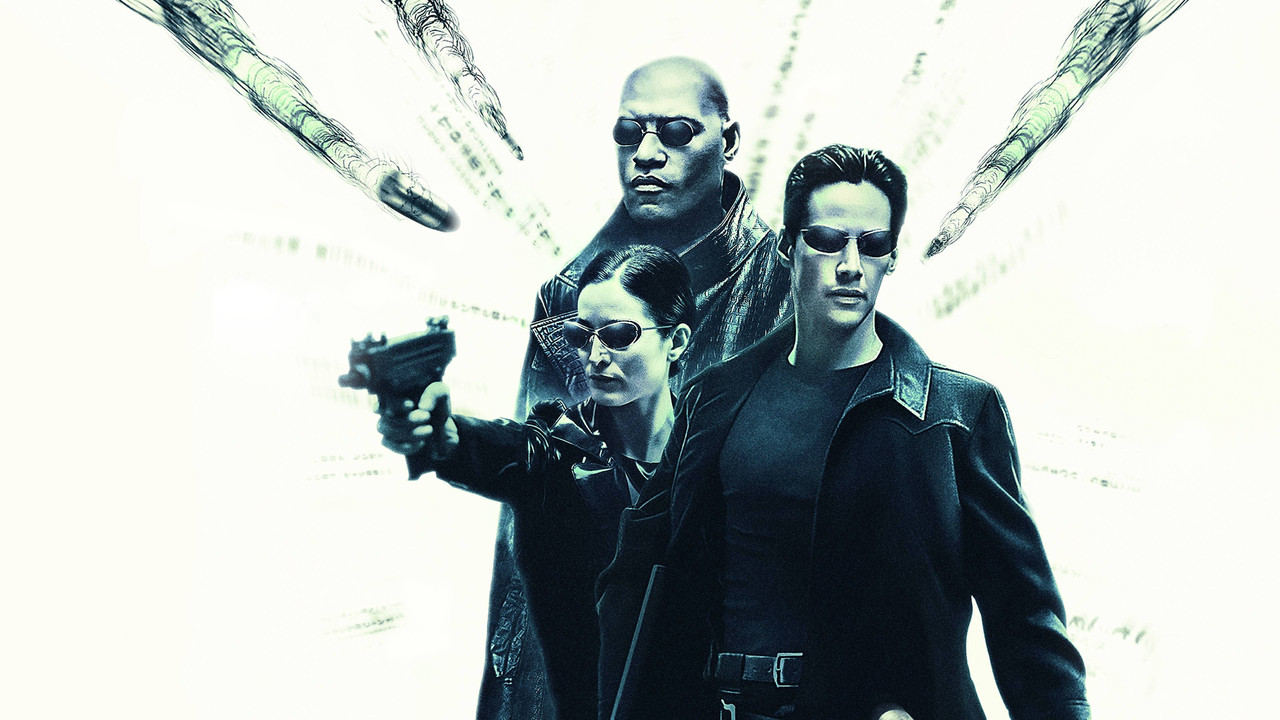
Writers: Lana Wachowski (screenplay), Lilly Wachowski (screenplay)
Cast: Keanu Reeves, Laurence Fishburne, Carrie-Anne Moss, Hugo Weaving, Gloria Foster, Joe Pantoliano
Thomas Anderson writes software by day and breaks into systems by night, under the name Neo, with the sense that something about the world is not being reported to him accurately. A man called Morpheus offers to show him what: the year is not 1999, the world he inhabits is a simulation maintained by machines, and human bodies are being farmed for power in vats while their minds run inside a consensual rendering of the late twentieth century. Neo accepts the offer, wakes up in the tank, and spends the rest of the film learning that the hard part was never escaping the simulation. It was learning to see the rules of a system that had been designed to be invisible from inside it.
The most useful thing about The Matrix is that the Matrix is not a villain. It is an optimisation. It runs correctly, it runs at scale, it delivers exactly what its operators need — a stable supply of power drawn from bodies that must be kept alive and quiescent — and it delivers to its subjects a world that is coherent, navigable and, in the ordinary sense of the word, functional. People go to work, raise children, get promoted, pay taxes. Nothing inside the experience reports the existence of the experience. That is not a flaw in the design; it is the design. Morpheus's opening description of the Matrix as something you can feel when you go to work or pay your taxes is often read as adolescent alienation, and it can be read that way, but it is also a precise account of how infrastructure behaves when it is working. Plumbing, payment rails, recommendation ranking, the escalation policy that determines which support ticket a human ever reads: all of these are most effective when nobody perceives them at all. The film's contribution is not the paranoid claim that we are being deceived. It is the harder observation that a system which serves its operators well and its subjects adequately generates no signal that would prompt anyone inside it to look for it.
Which is why the red pill is not an offer of freedom. It is an offer to see the infrastructure, and the film is unusually honest about what that costs. Neo wakes up in a tank, in a ruined world, on a leaking ship, eating protein slurry, among people who are objectively worse off in every measurable respect than the person he was that morning. Cypher, who takes the deal in reverse, is not written as a fool. He wants the steak, he knows the steak is not there, and he has run the calculation that most people run: the accurate model of the system is more painful than the comfortable one and confers no power he can use. Anyone who has understood a company's real incentive structure — as opposed to its stated strategy — recognises the position. Seeing the mechanism does not by itself give you leverage over the mechanism. It mostly gives you the inability to participate innocently. The film's respect for Cypher is what keeps it from being a fable about enlightenment, and it means the red pill has to be chosen on grounds that are not consequentialist. Morpheus never argues that the truth will make Neo happier. He argues only that it is the truth.
What is real? How do you define real? Morpheus asks this while Neo is having a mild breakdown in a loading program, and it sounds like undergraduate metaphysics until you notice that it is a data question. His follow-up is the operative part: if real means what you can see, smell, taste and touch, then real is electrical signals interpreted by the brain — which is to say, real is the output of an instrument, and the instrument can be fed. This is the condition of every organisation that perceives itself through a dashboard. The numbers on the screen are not the business; they are a rendering of the business, produced by an instrumentation layer that someone built, with sampling decisions, definitional choices and gaps that are invisible in the rendering itself. When the instrumentation is good the distinction is academic. When it is subtly wrong, the organisation does not experience wrong numbers; it experiences a different world, confidently, and acts in it. The spoon boy states the general case. The rule you are straining against is not a property of reality but a parameter of an implementation, and the leverage is not in bending the object but in locating the layer where the object is defined. Every engineer who has stopped fighting a config file and gone to read the code that parses it has had this scene.
The film's weakest passage is its politics of liberation and its strongest is its account of complicity. Morpheus warns Neo that the minds inside the system are not incidentally trapped but actively load-bearing: businessmen, teachers, lawyers, carpenters, so dependent on the arrangement that they will fight to defend it, which makes them dangerous rather than pitiable. This is the part that has aged into uncomfortable relevance, because it describes how any large sociotechnical arrangement defends itself — not through enforcers but through the ordinary interests of everyone whose livelihood is denominated inside it. The Agents are almost a distraction. The real mechanism is that reform threatens the people the reform is for. Twenty-five years of appropriation have flattened The Matrix into a slogan about waking up, usually deployed by people who have simply swapped one unexamined model for another, and the appropriation is a fair indictment of the film's iconography if not of its argument. What survives underneath is the less quotable claim: that systems which work are the hardest to see, that seeing them is expensive and unrewarded, and that the choice on offer is not between illusion and truth but between comfortable participation and an accurate view you may not be able to do much with.