The Manchurian Candidate
Writers: George Axelrod (screenplay), Richard Condon (based on the novel "The Manchurian Candidate")
Cast: Frank Sinatra, Laurence Harvey, Angela Lansbury, Janet Leigh, James Gregory
During the Korean War, a platoon of American soldiers is captured and brainwashed by Chinese and Soviet operatives. Sergeant Raymond Shaw returns home a decorated hero, programmed to kill on command when shown the queen of diamonds in a game of solitaire. His handler is not a foreign agent — it is his own mother, a senator's wife who has wired the conspiracy through the heart of the American political establishment she claims to be defending.
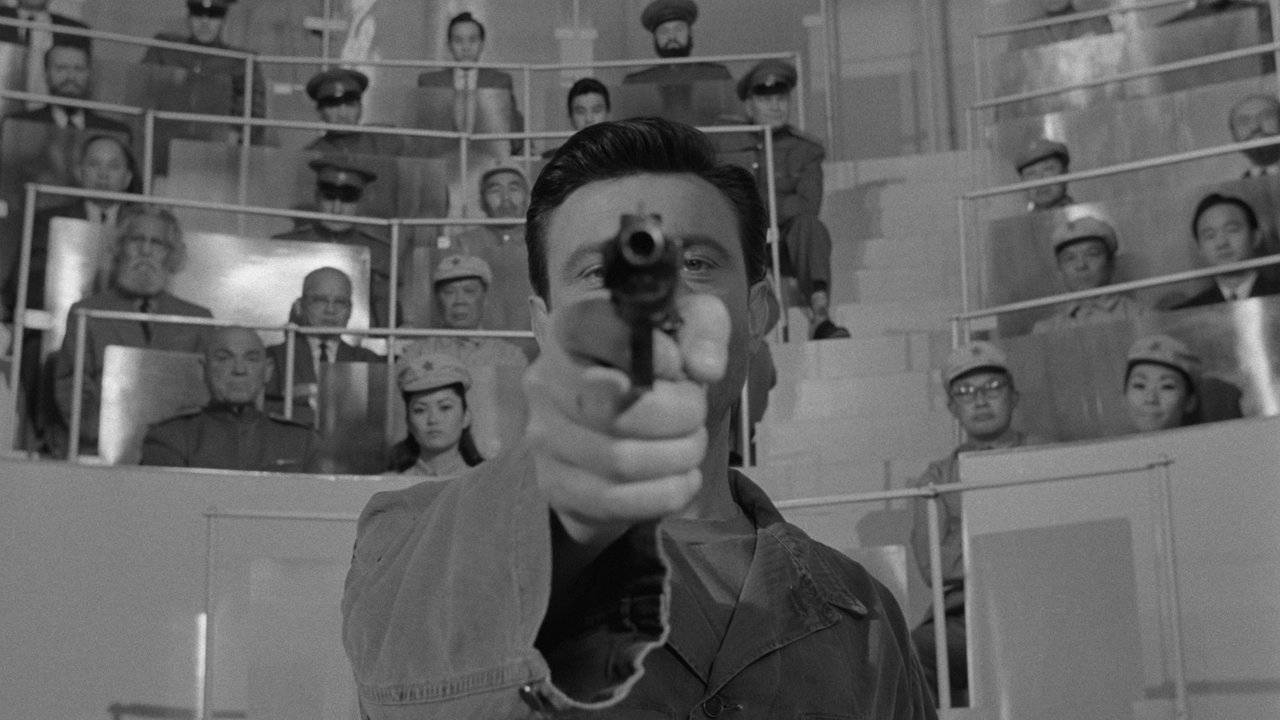
The most disturbing scene in The Manchurian Candidate is not the brainwashing sequence in Manchuria, where American soldiers sit in a hotel garden listening to a lecture on hydrangeas while in reality being demonstrated like laboratory specimens before an audience of Chinese and Soviet intelligence officials. The disturbing scene is any of the dozen moments, afterwards, when someone says "Raymond Shaw is the kindest, bravest, warmest, most wonderful human being I've ever known in my life." It comes out of the mouths of men who despise him — Shaw is cold, arrogant, friendless, the opposite of warm — and it comes out mechanically, identically, like an API returning its default response. Nobody who hears it questions it. Nobody who says it hears themselves saying it. The phrase has been planted so deep that it has become indistinguishable from belief, and the film's argument is that this is not a particularly exotic condition. Organisations do this as a matter of routine. They install a set of responses — values statements, strategic priorities, quarterly talking points — and once the installation is complete, the people repeating them cannot distinguish the implant from their own thinking. The refrain about Shaw is horrifying not because it is false but because the people saying it have no way to experience it as false. Their sincerity is total, and it is manufactured.
The plot, stripped to its mechanism, is a remote procedure call. Raymond Shaw has been programmed in Manchuria to respond to a specific trigger — the queen of diamonds in a hand of solitaire — with absolute compliance. When the trigger fires, Shaw will do whatever he is told: kill, forget, return to his normal personality with no memory of the event. He is a function that has been written, tested, deployed, and forgotten by its programmers until they need to invoke it. His mother, Eleanor Iselin (Angela Lansbury in a performance that remains one of cinema's most frightening) is both the programmer and the handler. And this is where the film's architecture becomes genuinely unsettling, because Eleanor is not an enemy agent in the conventional sense. She is a United States senator's wife, a fervent anti-communist, a creature of the American political system who has leveraged that system's own paranoia to install a kill switch inside the body politic. The back door was not built by the enemy. The back door was built by the defence establishment, using the enemy's tools, for purposes that serve no one's interest but Eleanor's own. The horror of The Manchurian Candidate is not that a foreign power compromised an American soldier. It is that the compromise was commissioned, facilitated, and exploited by the people who stand in front of cameras warning about foreign compromise.
This structure — the threat that comes from inside the house, wearing the house's uniform, speaking the house's language — is the one that organisations are least equipped to detect. Security models, whether in intelligence or in software, are built on the assumption that the perimeter separates trusted from untrusted. Everything inside the perimeter is ours; everything outside is theirs. The Manchurian Candidate demolishes this assumption with a character who is simultaneously inside and outside, trusted and compromised, a serving officer and a guided weapon. Eleanor Iselin has the highest clearance because she is the greatest threat, and the system that granted the clearance has no mechanism for reconsidering it, because the criteria for granting clearance assume that the people who designed the criteria are not the ones who need to be excluded. The film was released in 1962, withdrawn after Kennedy's assassination, and re-released decades later, and in every era it describes the same structural vulnerability: the one the system cannot patch because the patch would have to be approved by the component that is compromised.
Bennett Marco, the officer who begins to remember, is the film's secondary argument. He has the nightmares. He knows something is wrong. He cannot say what. When he finally cracks the programming, he does so not through intelligence work but through a form of pattern recognition that his own institution would not have sanctioned — obsessive, personal, operating outside channels. The army does not solve the problem. Marco solves the problem by ceasing to function as the army trained him to function and beginning to function as a person with a nightmare he cannot stop having. And Raymond Shaw, in the end, exercises the one freedom his programmers did not account for: he turns the weapon on them. The programmed component deviates from its specification, and the deviation is the most human thing in the film. It is also the only thing the system could not have modelled, because it arises from the very capacity — conscience, love, rage, the irreducible remainder of a person inside the program — that the programming was designed to suppress.