Det sjunde inseglet
Writers: Ingmar Bergman (written by, based on his play "Trämålning")
Cast: Max von Sydow, Gunnar Björnstrand, Bengt Ekerot, Nils Poppe, Bibi Andersson
Antonius Block, a knight returning from the crusades to a Sweden emptied by plague, finds Death waiting for him on a stony beach. He proposes a game of chess: as long as the game continues he lives, and if he wins he goes free. The game is played in instalments across a journey inland, alongside his squire Jöns, a family of travelling players, a blacksmith, a girl condemned as a witch and a procession of flagellants, while Block tries to work out what the reprieve is for.
Death has been walking beside Antonius Block for a long time; he says so at their first meeting, on a beach, without menace, as a matter of record. The line establishes what kind of adversary this is. He is not a threat that has appeared, he is a constraint that has always been in force and has only now become visible, and the distinction matters because it determines what a rational agent can do about him. There is no negotiating position here in the ordinary sense — no leverage, no alternative supplier, no appeal. Block's opening move is nonetheless to reach for the one thing he has: a game whose rules bind both players. He proposes chess because chess is a structure Death has agreed to enter, and inside a structure with agreed rules even an infinitely stronger opponent must take turns. This is the first negotiation with an implacable system in Western cinema and it is conducted correctly. When you cannot change the outcome, you change the format, because a format buys sequence, and sequence buys time.
Block's self-assessment is characteristically wrong in one specific way. He tells Death that he cannot possibly be the better chess player, and he is mistaken, but the mistake is not vanity — it is the standard error of the competent person meeting a system for the first time. He has beaten everyone he has ever played. He reasons from a sample that does not contain the case in front of him. Anyone who has watched a strong team discover that their track record was a property of the previous market rather than of themselves knows how this feels from the inside. What redeems Block is that his behaviour does not actually depend on the belief. He plays as though he might win and prepares as though he will not, and by the middle of the film he has stopped trying to win at all. The game continues because continuation is the entire benefit; the position on the board is almost irrelevant, and when he eventually sweeps the pieces over it is a tactical use of the game rather than a move within it.
What he wants from the reprieve is stated twice, and the two statements are not the same. In the church, at confession, he wants knowledge — not faith, not suppositions, but knowledge, God's hand extended, something he can verify. This is the demand of a man who has spent ten years in a crusade on the strength of an argument he can no longer reconstruct, and it goes unanswered because it is unanswerable; the priest in the confessional turns out to be Death, taking notes on his opening. The second statement is the one that survives. His life, he says, has been a futile pursuit, a wandering, a great deal of talk without meaning, and he says it without bitterness because most lives are like this — and then he decides to use his reprieve for one meaningful deed. That is the substitution the film is built on. Knowledge is not available; a single completed act is. It is the difference between a strategy that requires certainty about the environment and one that requires only a decision about what to do with the interval you have, and every functioning team operating under real uncertainty eventually makes the same trade.
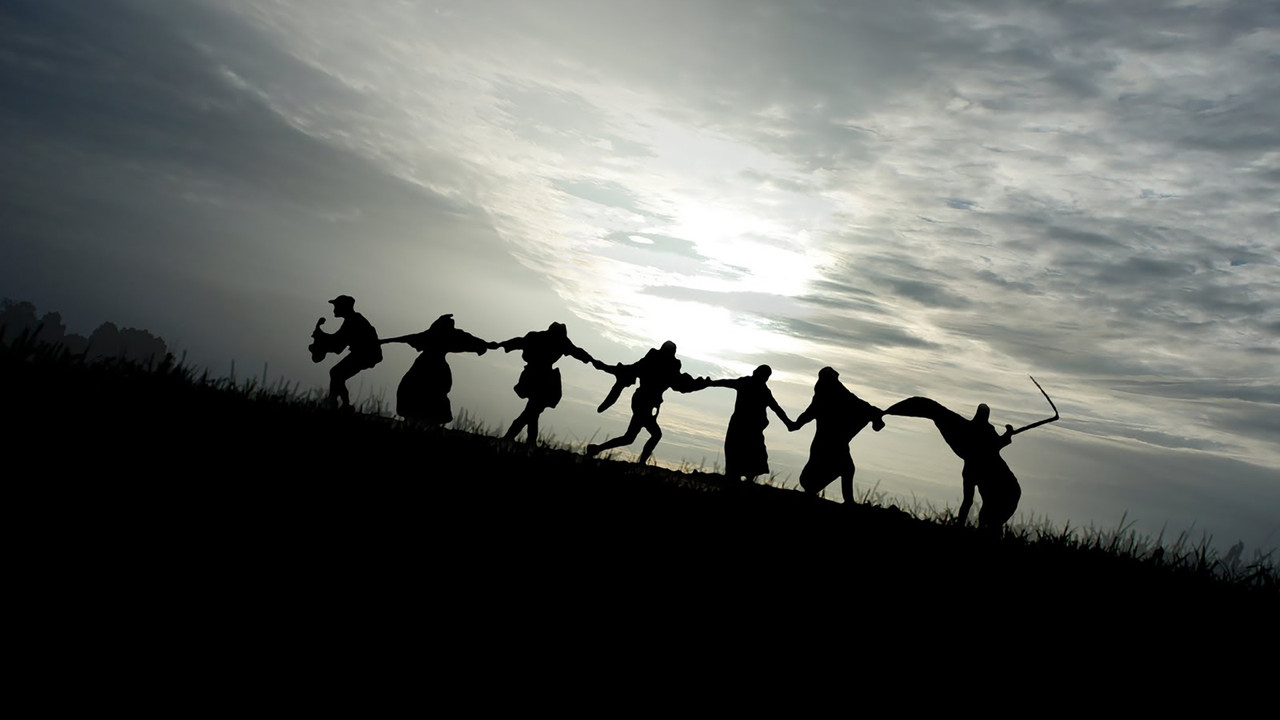
The deed itself is small, which is the point. He distracts Death long enough for Jof, Mia and their infant to slip away in a cart, and that is all — one family, no announcement, no proof it worked. Bergman places the emotional weight of the film not on the chessboard but on the meal before it, where Block sits with the players over wild strawberries and milk in the evening light and says aloud that he will remember this: the silence, the twilight, the bowls, their faces. He is deliberately committing something to memory in a world where nothing else can be held. Death's parting statement is accurate — nothing escapes him, no one escapes him, and the dance across the hillside at the end takes everyone including Block. The reprieve changed the outcome for nobody except three people who never learn what it cost. Every planning conversation that asks what can actually be shipped before the deadline is running Block's calculation, usually without noticing that the interesting variable is not how much time can be bought but what the time is being bought for. Block is the rare case of someone who answers the second question. He does not know whether it mattered. He does it anyway, and the film declines to tell us he was right.