The Compass and the Terrain: Readings on the Direction of Digital Products
Annotated bibliography
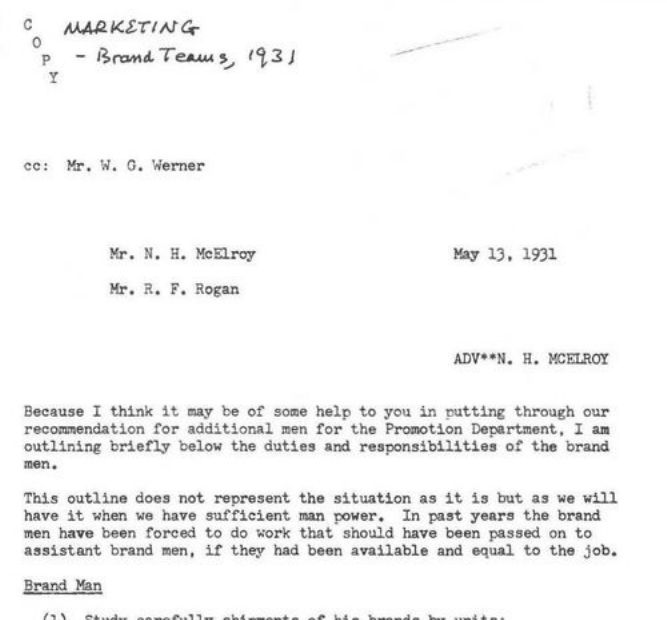
In 1931, a twenty-seven-year-old advertising manager at Procter & Gamble named Neil McElroy wrote a three-page memo proposing a new role. He called it "Brand Man." The idea was simple and, at the time, radical: one person should be responsible for the entire fate of a single product — its positioning, its competition, its performance. Not the factory. Not the sales team. The product itself should have a dedicated mind thinking about it full-time.
McElroy's memo is often cited as the birth certificate of product management. But the real story is less tidy. The discipline that would eventually be called "product management" was not designed; it assembled itself from pieces that didn't know they belonged together. Management science gave it the language of results and efficiency. Manufacturing gave it the logic of flow and the elimination of waste. Strategy gave it the habit of choosing what not to do. Design gave it empathy. Software engineering gave it iteration. And the internet gave it a medium where all these forces interact simultaneously, at a speed that makes most inherited frameworks inadequate.
This collection traces the lineage. It is not a syllabus — it is an itinerary through the intellectual traditions that converged into what we now call product direction. The question running through it is one that McElroy implicitly asked and that remains open: what does it mean to be responsible for a product whose nature you don't fully control?
The itinerary begins before "product management" had a name, with the management thinkers who established that organisations exist to produce results, not to perpetuate themselves. It moves through the lean revolution and the discovery that the factory floor — like the codebase — is a thinking system. It follows the emergence of product-specific practices: iterative development, validated learning, continuous discovery. And it arrives at the contemporary question that defines the discipline today: not how to build, but how to organise so that good products become possible.
The compass is what you bring — principles, strategy, taste. The terrain is what you find — users, markets, technology, the organisation itself. Product direction is the ongoing negotiation between the two.
The manager before the product manager
Managing for Results
Drucker's 1964 book — one of the first serious treatments of business strategy as a discipline — is the source of many ideas that contemporary management takes for granted: the focus on results over activity, the categorisation of products by revenue and cost dynamics, the argument that the purpose of a business is to create a customer.
The book is clear and surprisingly modern, which is typical of Drucker; he wrote with unusual clarity for his discipline.
For product direction it is foundational reading on what management actually is, and a useful counterweight to the more specialised contemporary frameworks.
Drucker is worth reading widely; this is a good starting point.
Innovation and Entrepreneurship: Practice and Principles
Drucker's argument is that innovation is not a flash of genius but a discipline — a systematic practice that can be learned and managed.
The book identifies seven sources of innovation (the unexpected, incongruities, process needs, industry changes, demographic shifts, changes in perception, new knowledge) and insists that most successful innovations exploit the boring ones, not the glamorous ones.
For product direction this is the most pragmatic book about innovation on the shelf: it replaces the myth of the visionary with the practice of the alert observer.
Drucker's prose is characteristically clear and the examples, though dated, illustrate principles that have not aged.
Read alongside Christensen's The Innovator's Dilemma for the complementary argument about why established firms fail to innovate.
The factory as a thinking system
Toyota Production System: Beyond Large-Scale Production
Ohno invented the Toyota Production System and this is his own account of how and why — not Liker writing about Toyota, but the man who built it describing the thinking underneath.
The book is short, conversational, and deceptively simple: just-in-time, autonomation (jidoka), the elimination of waste, the respect for people who do the work.
For product direction this is the primary source that Lean, Kanban, and most contemporary agile practices descend from, and reading the original clarifies how much has been lost in translation.
Ohno's Toyota is not about efficiency; it is about thinking.
Read alongside Liker for the codified version and Deming for the statistical-quality complement.
Output as the measure
High Output Management
Grove ran Intel during its most consequential decades and the book is his operational manual for management — written not as theory but as a description of what he actually did.
The book covers one-on-ones, performance reviews, decision-making, production principles applied to knowledge work, and the concept of managerial leverage (the output of a manager is the output of the organisation under them).
For product direction it is the single most cited management book in Silicon Valley for a reason: it treats management as a craft with specific techniques, not as a soft-skill overlay on top of the real work.
Doerr's Measure What Matters descends directly from Grove's OKR practice. Read it early and reread it often — it improves with experience.
The game that changed the rules
The New New Product Development Game
The HBR article that introduced the "rugby" metaphor for product development — overlapping phases, shared responsibility, the whole team moving down the field together — which Jeff Sutherland and Ken Schwaber would later crystallise as Scrum.
Takeuchi and Nonaka studied Japanese companies (Fuji-Xerox, Honda, Canon, NEC) and described a pattern that had emerged there: not the sequential relay of specifications handed off between departments, but overlapping self-organising teams with ambiguous goals and high autonomy.
Reading it today is illuminating for two reasons: the practice they describe is more demanding than the lightweight Scrum that inherited its label, and its roots in Japanese management culture explain why it often degrades in translation.
Required reading on how contemporary product organisations took their shape.
Strategy is not a plan
Good Strategy Bad Strategy: The Difference and Why It Matters
Rumelt's argument is cutting: most of what gets called "strategy" in organisations is not strategy at all — it is goals, or slogans, or lists of initiatives.
Real strategy has a kernel: a diagnosis of the situation, a guiding policy, and a coherent set of actions.
Without all three you have bad strategy, which is often worse than no strategy because it commits resources in a direction that cannot succeed.
For product direction this is the most diagnostic book on strategy in print; Rumelt's vocabulary (kernel, bad strategy, chain-link systems) survives contact with actual strategy meetings.
Read alongside Porter for the theoretical foundations, Magretta for a compressed Porter, and Rumelt for the operational critique.
What Is Strategy?
Porter's short, canonical HBR article that argues strategy is about choosing to do things differently, not about doing the same things better — operational effectiveness is necessary but not strategic.
The piece's most useful distinction is between activities that improve operational effectiveness (convergent, winnable only on a treadmill) and activities that create a distinctive strategic position (fit between activities, hard to imitate).
For product direction, reading Porter's original is more useful than reading summaries of Porter — the argument is more specific than the summaries suggest and more applicable to actual strategy conversations.
Short, dense, canonical. Pair with Magretta for the book-length expansion and Rumelt for the operational critique.
The Innovator's Dilemma
Disruption from below: initially inferior technologies that serve ignored markets and end up displacing incumbents.
Established firms fail not from incompetence but because their processes, values and metrics are optimised for the current market, not the emerging one.
Relevant to AI because agentic tools let small teams inside the organisation disrupt internal processes without asking for permission — disruption is no longer only external.
The bar moves: you are not only competing with a startup, you are competing with a team of five inside your own company wielding Claude.
The market that reveals itself
Crossing the Chasm: Marketing and Selling Disruptive Products to Mainstream Customers
Moore's central model: the technology adoption lifecycle has a gap — the chasm — between early adopters (who buy on vision) and the early majority (who buy on references and pragmatism), and most technology products die in that gap because the go-to-market strategy that won early adopters does not work on pragmatists.
The book prescribes a specific sequence: pick a beachhead segment, dominate it, use it as a reference base to cross into adjacent segments.
For product direction the model is the canonical framework for understanding why products with enthusiastic early users stall at scale.
The examples are dated (1991 vintage); the framework has not been replaced.
Read alongside Christensen's The Innovator's Dilemma for the disruption complement and Ries for the validation stage that precedes the chasm.
The Four Steps to the Epiphany: Successful Strategies for Products that Win
The book that coined the discipline of customer development and seeded everything "lean startup" later systematised.
Blank's claim is that startups fail not because of bad products but because they sell to the wrong customers in the wrong way, and that the fix is a methodical process of learning about customers before scaling.
The book is unpolished and repetitive — Blank self-published it because no editor knew what to do with an argument structured as a manual rather than a narrative.
Read it as the more rigorous predecessor of Ries.
For product direction the useful inheritance is the distinction between customer discovery (is there a problem?) and customer validation (will they buy the solution?) — a checkpoint most teams collapse into a single blurry "research" phase and then pay for.
The Lean Startup: How Today's Entrepreneurs Use Continuous Innovation to Create Radically Successful Businesses
Ries popularised a vocabulary — MVP, pivot, validated learning, build-measure-learn — that became the lingua franca of startups in the 2010s.
Strip away the evangelism and the argument is tight: when uncertainty is high, the right unit of progress is not a feature shipped but a hypothesis tested.
That single reframe is the book's real contribution.
Ries's debt is to Toyota and Deming more than to Silicon Valley, even if the audience reads him the other way around.
Reading it now is an exercise in historical grounding: every "lean" practice in contemporary product culture started here, and most of them have been degraded in transit.
The economics underneath
The Principles of Product Development Flow: Second Generation Lean Product Development
Reinertsen writes the book most "lean" advocates should have written and didn't: a rigorous, economics-based account of why batches, queues and variability govern the speed of product development.
The argument is quantitative — cost of delay, WIP limits, capacity utilisation curves — and often counterintuitive.
Running teams at 100% utilisation destroys throughput; holding inventory has a measurable cost; smaller batches are almost always cheaper end-to-end than large ones.
It is the deepest book on the page about why shipping faster is not about working harder.
For a product director it clarifies the physics of the system you manage, not the psychology; dense, essential, worth re-reading every year.
Lean Software Development: An Agile Toolkit
The Poppendiecks translate Toyota's manufacturing principles into software terms: eliminate waste, amplify learning, decide as late as possible, deliver as fast as possible, respect people, see the whole.
The translation is literal enough to be rigorous and loose enough to be useful.
The seven wastes of software (partially done work, extra features, relearning, handoffs, task switching, delays, defects) are the single most portable diagnostic tool a product director can carry into any team.
Read alongside Reinertsen for the economic argument and Anderson for the implementation. It is not motivational literature; it is a manual.
Discovering what to build
Continuous Discovery Habits: Discover Products that Create Customer Value and Business Value
Torres turns the vague practice of "talking to users" into a weekly rhythm: interviews every week, opportunity solution trees, assumptions framed as testable hypotheses, and a discipline for getting from conversations to decisions without romanticising either side.
The book is operational in the best sense — it is mostly about habits, cadence and the small rituals that make discovery survive the pressure of delivery.
For product direction it is one of the cleanest arguments against the false choice between discovery and delivery; Torres shows how a team runs them in parallel without either starving the other.
A useful companion to Blank's customer development in its more ritualised form, and a book to hand every PM on the team.
The Inmates Are Running the Asylum: Why High-Tech Products Drive Us Crazy and How to Restore the Sanity
Alan Cooper invented Visual Basic's interaction model and then spent the rest of his career arguing that engineers should not design the products they build.
This book introduced personas as a design method — not the diluted marketing personas used today, but richly researched archetypes grounded in behavioral patterns.
Cooper's core claim is that software is hostile to normal people because the people who build it optimize for their own mental models, and that design must be an independent discipline with authority in the development process.
The book was published in 1999, when this was a genuinely controversial position in the industry, and Cooper fought the cultural war for design's seat at the table when almost no one else was fighting it.
The organizational argument — that interaction design must happen before engineering begins — remains uncomfortable and largely unimplemented in most product teams.
Mapping Experiences: A Complete Guide to Creating Value Through Journeys, Blueprints, and Diagrams
Kalbach's book is a reference manual for the visual tools of experience design — journey maps, service blueprints, empathy maps, ecosystem diagrams.
What makes it useful rather than just an inventory is the discipline Kalbach imposes: each tool has a specific purpose, specific inputs, specific failure modes, and they are not interchangeable.
For product direction it is the kind of book that makes a team stop arguing about which workshop to run and start picking the tool that fits the problem.
The second edition, updated in 2020, is the one to read. Kalbach writes with operational clarity — no dogma, much craft.
What the product asks of the organization
Inspired: How to Create Tech Products Customers Love
Cagan's guide to how the strongest tech product organisations actually operate — empowered product teams, product discovery, continuous delivery, the difference between feature factories and outcome-driven teams.
The book gathers decades of Silicon Valley product practice into a structured argument that is more polemical than it reads: most companies calling themselves "product-led" are running a cargo-cult version of what Cagan describes.
For a product director it is a checklist of where the gap lies between rhetoric and practice.
The second edition is the essential one — Cagan sharpened it after a decade of consulting exposure to companies that had read the first and still got it wrong.
Read alongside Empowered for the leadership layer.
Empowered: Ordinary People, Extraordinary Products
Cagan's sequel to Inspired — where Inspired describes what strong product teams do, Empowered describes what product leadership does to produce them.
The book is organised around coaching, recruiting, product vision, and team topology, with specific attention to the leader's failure modes.
For product direction this is the more useful of the two Cagan books if you are already directing teams: Inspired is for PMs, Empowered is for heads of product.
Read alongside Skelton and Pais's Team Topologies for a complementary structural argument.
Cagan's prose is not elegant but it is clear; this book is argument rather than memoir.
Escaping the Build Trap: How Effective Product Management Creates Real Value
Perri's book names a condition that most product organisations fall into without noticing: the build trap, where shipping features becomes the measure of progress and the connection between those features and actual outcomes is quietly severed.
The book is structured as an argument for outcome-led product management — what it looks like, how it differs from output-led work, what organisational conditions make it possible.
For product direction this is one of the clearest diagnostic vocabularies in contemporary product writing; many teams only notice they are trapped once Perri gives them the words.
Read alongside Cagan's Inspired and Empowered for the broader Silicon Valley consensus this piece participates in.
A usefully uncomfortable book.
Culture as the real product
What Makes a Strong Product Culture?
Norton's essay on product culture is a compressed argument about what distinguishes strong product organisations from the rest — not the rituals or the frameworks, but the shared sense of what good product work looks like.
The piece is useful because Norton is one of the few contemporary voices willing to argue that product is a craft rather than a process, and that culture is what keeps craft alive.
For product direction the essay is a short diagnostic: most organisations that describe themselves as "product-led" are using the words without the underlying culture, and Norton's test is sharper than most.
Pair with Cagan's Establishing a True Product Culture for a complementary take.
Establishing a True Product Culture
Cagan's SVPG essay on what it takes to establish a real product culture — not the performative version, the version that actually makes a product organisation produce better products.
The piece is more direct than most of Cagan's book-length work, which is its value: it names the specific conditions (empowered teams, continuous discovery, product leadership) that most organisations claim to have and do not.
For product direction it is a useful short summary of Cagan's broader argument across Inspired and Empowered.
Pair with Norton's What Makes a Strong Product Culture? for the complementary view.
SVPG's site is the best single source of contemporary product-management writing; browse it.
No Rules Rules: Netflix and the Culture of Reinvention
Hastings and Meyer jointly reconstruct the Netflix operating system — not as a set of policies but as a set of dependencies: talent density enables candor, candor enables the removal of controls, and the removal of controls enables speed.
The distinctive contribution over McCord's Powerful is Meyer's cross-cultural research layer, which forces the reader to see that the Netflix model is not universal but culturally specific, and that exporting it requires translation.
For product direction the book is valuable as the most complete articulation of a high-autonomy, high-accountability culture written by the CEO who built it, warts included.
The frank treatment of failures (the Qwikster debacle, the culture clash in international expansion) makes it more useful than the typical founder memoir.
Read alongside McCord for the operator perspective and Horowitz's What You Do Is Who You Are for a fundamentally different theory of how culture is programmed.
Measuring what matters
Measure What Matters: How Google, Bono, and the Gates Foundation Rock the World with OKRs
Doerr's book is the popular introduction to OKRs — objectives and key results — the goal-setting system Andy Grove developed at Intel and Doerr carried to Google and from there to most of Silicon Valley.
The case studies are the strongest part: Bono, the Gates Foundation, early Google, showing OKRs working in settings where the usual management vocabulary falls apart.
The framework itself is deceptively simple; the book's real value is in the chapters that walk through how teams fail at it, which are more instructive than the success stories.
For product direction it is worth reading even if your organisation uses a different system — the book's diagnostic on goal-setting is portable.
Pair it with Grove's High Output Management (the source text) for the deeper version.
Outcomes Over Output: Why Customer Behavior Is the Key Metric for Business Success
Seiden's short book makes one argument clearly: the right measure of product success is not what you shipped (output) but what changed in customer behaviour (outcome).
The book is deliberately concise — under a hundred pages — and that compression is its value.
For product direction it is a useful pocket reference for the most common conversation in product organisations: the one where shipping features is confused with making progress.
Read alongside Perri's Escaping the Build Trap for the longer treatment and Doerr's Measure What Matters for the goal-setting complement.
Short enough to read in an afternoon, portable enough to carry into meetings.
Lean Analytics: Use Data to Build a Better Startup Faster
Croll and Yoskovitz wrote the operational companion to Ries's theoretical argument in The Lean Startup.
Where Ries argues that validated learning is the right unit of progress, Croll and Yoskovitz tell you which numbers to actually look at at each stage of a startup and what they mean.
The "One Metric That Matters" framing is their most portable idea — at any given moment there is usually a single number whose movement contains most of what you need to know, and picking it forces the hard conversation about what you are actually trying to do.
Read alongside Doerr for the goal-setting layer and Varian for the pricing mechanics. More useful than it is elegant.
The shape of teams
Team Topologies: Organizing Business and Technology Teams for Fast Flow
Skelton and Pais take Conway's Law seriously and build an operating model from it: four fundamental team types (stream-aligned, enabling, complicated-subsystem, platform) and three interaction modes (collaboration, X-as-a-service, facilitating).
The book is the most operational treatment of how to organise product and engineering teams for sustained delivery speed, and its vocabulary has been adopted widely since publication.
For product direction it is directly useful — most organisational friction is a team-topology problem, and having the vocabulary to diagnose it changes the conversation.
Read alongside Conway's original paper, Cagan's Empowered for the product-leadership complement, and McChrystal's Team of Teams for the military parallel.
The book that should have existed ten years earlier.
Turn the Ship Around! A True Story of Turning Followers into Leaders
Marquet took command of a nuclear submarine with the lowest performance ratings in the US Navy and turned it into one of the highest, largely by inverting the relationship between command and initiative — moving from "I will, sir" to "I intend to" as the default communication mode.
The book is the specific operational account of how he did it, with unusually concrete examples of the moments where the shift happens or fails.
For product direction the transfer is direct: distributed authority is the challenge most product organisations face, and Marquet's account is more specific about how to produce it than the usual leadership literature.
Short and memoir-style; deceptively deep.
Process as a hypothesis
Kanban: Successful Evolutionary Change for Your Technology Business
Anderson's central claim is subtle: you do not adopt Kanban, you discover it by making your current work visible.
Start where you are, make WIP limits explicit, manage flow — and the process improves itself.
The virtue of the book is that it does not ask organisations to reorganise before they start; it asks them to look, which is much harder.
Reinertsen's queueing theory sits underneath, but Anderson gives you the operating manual.
For product direction it is a useful antidote to the cargo-cult of Scrum ceremonies — evolutionary change beats imposed change in most teams most of the time.
Shape Up: Stop Running in Circles and Ship Work that Matters
Shape Up is Basecamp's operating manual for product development, written by Ryan Singer after a decade of practice: six-week cycles, two-week cool-downs, "appetite" instead of estimates, teams responsible for both shaping and building their own work.
The method is the clearest alternative to Scrum currently in circulation, and the book is unusual in being both opinionated and honestly bounded — Singer tells you what it works for (small, focused teams building product) and what it doesn't (anything at large scale with heavy dependencies).
For product direction the most portable concept is probably appetite: deciding upfront how much time a problem deserves, rather than estimating how long a solution will take.
Short, free online, and deserves the attention it still gets years later.
The people who lead
The Manager's Path
The standard book for the individual contributor-to-manager transition in technology companies, structured as a progression from mentoring an intern through managing a team, managing managers, and eventually running an engineering organisation.
Fournier, who was CTO of Rent the Runway, writes from direct experience and avoids the abstract leadership platitudes that plague most management books.
The chapter on managing managers is particularly valuable because it addresses a transition that most engineering organisations handle badly — the moment when your job stops being about technical decisions and becomes about building the system that makes good technical decisions possible.
It has become the de facto onboarding text for new engineering managers across the industry.
An Elegant Puzzle: Systems of Engineering Management
Larson codifies the engineering management knowledge that was previously tribal — how to size teams, how to run migrations without halting feature work, how to handle organizational debt, how to design career ladders that do not incentivise the wrong behaviour.
Written from his experience at Uber, Stripe, and later as CTO of Calm, the book treats engineering management as a systems design problem rather than a people skills problem, which makes it unusually rigorous for the genre.
The Stripe Press edition is itself a statement: beautifully produced, it signals that engineering management deserves the same seriousness as the technical disciplines it governs.
Pairs well with Fournier's The Manager's Path — where Fournier maps the career progression, Larson provides the operating manual for each level.
The Staff Engineer's Path
A book about what senior individual contributors actually do in large organisations — the work that creates value when you no longer write most of the code yourself.
Reilly, a principal engineer at Squarespace, describes three pillars of staff-level impact: big-picture thinking, execution of cross-team projects, and levelling up the engineers around you.
The book is valuable precisely because this role is poorly defined at most companies, leaving staff engineers to either become shadow managers or retreat into isolated technical work, neither of which justifies the title.
For product directors, it clarifies the engineering counterpart to their own role: the person whose job is to ensure that technical decisions across teams are coherent, even when no single team owns the problem.
Managing Oneself
Drucker's short HBR essay — written at eighty-nine — argues that the central task of a knowledge worker is to know themselves: their strengths, how they learn, how they work with others, what they value, and where they belong.
The essay is a rare case of a management thinker turning the lens inward with full seriousness, and the advice is concrete: take the feedback analysis, discover whether you are a reader or a listener, know whether you perform best as a subordinate or a decision-maker.
For product direction it is quietly foundational — most career problems in product leadership are self-knowledge problems, and Drucker names them precisely.
Read alongside his Managing for Results for the outward-facing complement. Short, late Drucker; every sentence earned.
Complementary readings
The Business Model Navigator: 55+ Models That Will Revolutionise Your Business
Gassmann and colleagues at St.
Gallen catalogued fifty-five recurring business model patterns — freemium, razor-and-blade, two-sided markets, sensor-as-service, and dozens more — and argue that most successful business model innovation is recombination, not invention.
The book is a pattern library rather than a theory, which is precisely its use: designers use catalogues, theorists use theories, and most product directors need catalogues more often than theories.
Read alongside Osterwalder's canvas, which gives you the structure into which Gassmann's patterns are slotted.
For product direction it is a fast antidote to the belief that the only business models on offer are the ones you already know.
Usefully indexed; it is a reference more than a read.
How Google Works
Schmidt and Rosenberg's account of how Google operated during its growth years — the specific structures, hiring practices, meeting formats and strategic moves that produced the company as it is.
The book is heavily branded but the operational material underneath is substantial, particularly the chapters on what the authors call "smart creatives" — the kind of people Google built its organisation to attract and retain.
For product direction it is a useful data point on one way to run a successful tech company at scale.
Read it selectively; the self-promotional parts are easy to skip, the structural parts are worth the time.
Weaving the Web
The story of the World Wide Web told by its creator.
The most relevant thing is not the technology but Berners-Lee's insistence that there was no grand plan — only a problem to solve (sharing information between CERN researchers) and a spirit of openness.
The web was not designed top-down; it was woven. Berners-Lee actively resisted centralising and privatising the protocol.
Essential reading for the narrative thread that the deepest transformations often arise without a plan, driven by necessity and curiosity — and that keeping them open is itself a design choice.
Product Leadership: How Top Product Managers Launch Awesome Products and Build Successful Teams
A collection of interviews and case studies across senior product leaders — Cagan, Norton, Harding, and many others — organised around the practical problems product leaders face.
The format (interviews rather than a single authored argument) is both its strength and its limit: you get a wide range of voices, but less coherent argument.
For product direction it is a useful survey, particularly for product managers thinking about the transition to leadership.
Read it alongside Cagan's Empowered for a single sustained argument on the same question. A good book for the shelf, not the canon.
High Growth Handbook
The operational handbook for scaling startups from product-market fit through rapid growth to IPO, based on Gil's experience as a founder and operator at Google and Twitter and on extensive interviews with people like Marc Andreessen, Reid Hoffman, and Sam Altman.
The book is more tactical than most in this library — it covers board management, M&A mechanics, executive hiring, and late-stage fundraising with a specificity that few authors are positioned to provide.
Gil's particular strength is his treatment of the phase transitions that organisations go through as they scale: the practices that work at fifty people actively harm you at five hundred, and recognising the transition points is a skill most founders learn too late.
For product directors, the chapters on product management at scale and on building an executive team are directly applicable.
It is the kind of book you keep on your desk during a specific period of organisational growth and then hand to the next person entering that phase.
Content Strategy for Mobile
McGrane articulated what responsive design alone could not solve: that adapting layout to screen size is meaningless if the content itself was never structured for reuse across contexts.
The book argued that mobile is not a design problem but an editorial and organisational one — companies fail at mobile because their content is trapped in desktop-shaped blobs with no semantic structure, no metadata, and no separation between meaning and presentation.
Published a year after Marcotte's Responsive Web Design, it served as the necessary counterweight: where Marcotte addressed the container, McGrane addressed what goes inside it.
The distinction between adaptive presentation and adaptive content remains one of the most underappreciated ideas in product work.
Introducing a Product Delivery Culture at Etsy
Cochran's essay is a case study of Etsy's deliberate effort to rebuild its product delivery culture during a period of stall and recovery.
What makes it worth reading is the specificity: concrete practices, concrete leadership moves, concrete outcomes — not an abstract playbook.
For product direction it is one of the best recent accounts of how culture is actually changed inside a large organisation, which is to say slowly, through a sequence of small structural interventions that accumulate.
Part of Martin Fowler's "Bottlenecks of Scaleups" series, which is worth browsing in full.
Use this piece as a counterweight to the abstract strategy literature elsewhere in the library.
Amazon's Single-Threaded Model
Gallego's post on Amazon's single-threaded leader model — the principle that any important initiative gets a leader whose single responsibility is that initiative, with no competing demands.
The model is one of the lesser-publicised reasons Amazon has been able to ship new product lines at scale: the absence of split attention at the top.
For product direction the transfer is specific — if a product initiative matters, treat its leadership as a scarce resource and protect it from being thinly spread across other priorities.
Short and concrete. Useful to share when someone proposes that a product director "also manage" a second unrelated initiative on the side.
Three Product Teams
John Cutler's short piece distinguishing three kinds of product teams — delivery teams, product teams, and what he calls business-model / outcome teams — by the scope of what they are responsible for.
The distinction is useful because most organisations have one kind and assume they have another, and the resulting misalignment produces most of the friction around product teams.
For product direction it is a compact diagnostic.
Cutler's broader "Beautiful Mess" substack is one of the more consistently thoughtful places on the internet for product team design; read widely there.
Pair with Cagan's Empowered for the broader argument.
Why Product Request SLAs Fail
Mironov has been writing the most consistently useful voice on the daily operational reality of product management for two decades.
This piece is a short argument against a specific anti-pattern: internal stakeholders pushing product teams to commit to service-level agreements on request turnaround, as if product were a ticketing desk.
Mironov's response is surgical — SLAs work when the work is commodified and predictable, both of which are definitionally untrue of product work.
For product direction the piece is useful vocabulary for a conversation many PMs have regularly and badly.
Pair it with Mironov's broader blog — there is no better operational complement to the strategic literature.
Empathy and Product Management
Ken Norton spent a decade running product at Google Ventures and writes one of the more humane newsletters in the product management space.
This piece is about empathy as a working practice — not a posture but a set of specific moves PMs make in meetings, in customer conversations, in decisions about what to prioritise.
Norton connects empathy to a craft of product management that he argues has been hollowed out by process and metrics.
Short, concrete, worth sharing with new PMs.
The broader blog is worth subscribing to as a thoughtful complement to the more breathless product commentary elsewhere.
Amplitude's playbook on how to pick a North Star metric — the single measurable number that represents the value a product delivers to its users — and how to structure product strategy around it.
The playbook is opinionated, operational, and written by people who have seen the method succeed and fail at scale.
For product direction it is a useful reference on a specific question that comes up often and that most teams answer badly.
The North Star idea can be reductive when misapplied (not every product reduces cleanly to one number), but the discipline of attempting it usually exposes strategic confusion that would otherwise stay hidden.
Pair with Croll and Yoskovitz's Lean Analytics for the broader metrics conversation.
37signals' original book, released free in 2006, that codified the early philosophy of the company: small teams, short cycles, simple products, no meetings, shipped software over polished presentations.
The book predates Shape Up and is less systematic, but several of its arguments were ahead of their time and became mainstream — the distinction between features and overhead, the critique of requirements documents, the emphasis on real software over mockups.
For product direction it is a short, opinionated read; much of it has been absorbed into common practice without attribution.
Use it as historical grounding for the contemporary 37signals output (Rework, Shape Up) that continues the argument in sharper form.
The Elements of User Experience: User-Centered Design for the Web and Beyond
Garrett's five-layer diagram — strategy, scope, structure, skeleton, surface — became the canonical way UX is taught and discussed, and it did so because it solved a real communication problem: designers, developers, and product managers were talking past each other by conflating decisions that belong at different levels of abstraction.
The book gave the field a shared vocabulary for distinguishing business objectives from content requirements from information architecture from visual design.
Its influence is so pervasive that many practitioners use the framework without knowing its origin.
The limitations are real — the layers suggest a cleaner separation than practice allows, and the model is better at describing than prescribing — but as a mental map for organizing the chaos of product decisions, nothing simpler has replaced it.
Read it to understand the scaffolding beneath every UX conversation you have ever had.
Don't Make Me Think: A Common Sense Approach to Web Usability
The most widely sold web usability book ever written, and it earns the distinction by being short, funny, and relentlessly practical.
Krug's central argument is that users do not read pages — they scan them, and every element that requires thought is a cost the designer chose to impose.
The book demolished the then-common practice of debating design decisions through opinion by demonstrating that a morning of hallway usability testing reveals more than a month of meetings.
Its lasting contribution is not any specific guideline but the attitude it instilled: usability testing can be fast, cheap, and informal, so there is no excuse for not doing it.
Twenty-five years later, many teams still do not test with real users, which makes this book's argument as urgent as it was in 2000.