All Quiet on the Western Front
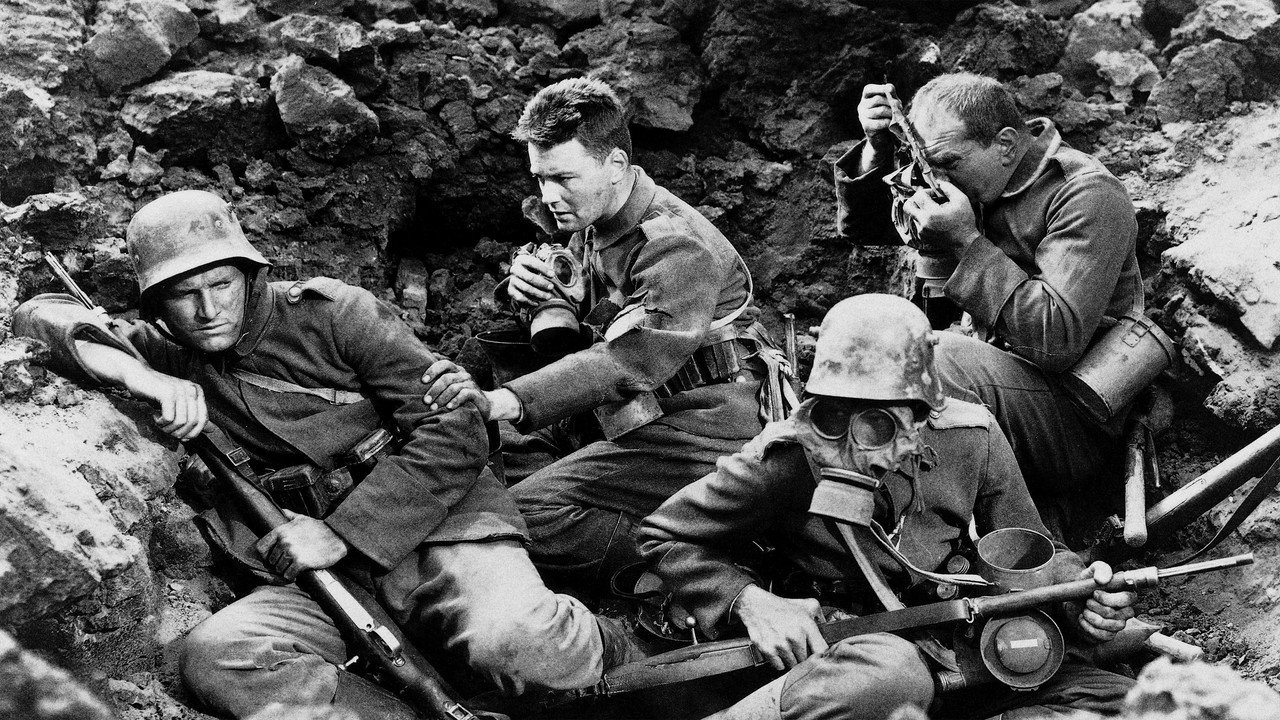
Writers: George Abbott (screenplay), Erich Maria Remarque (based on the novel "All Quiet on the Western Front")
Cast: Lew Ayres, Louis Wolheim, John Wray, Arnold Lucy, Ben Alexander
A class of German schoolboys, swept up by their teacher's patriotic rhetoric, volunteer for the Imperial Army and are sent to the Western Front in 1914. What they find there has no relationship to what they were told to expect, and when they try to bring that knowledge back, the institution that produced them has no mechanism for receiving it.
The schoolmaster Kantorek stands at the front of his classroom and delivers a speech about duty, honour, and the fatherland. His students — boys, essentially, seventeen and eighteen years old — are moved to volunteer for the army. The speech is beautifully constructed. It builds from historical example to moral imperative to personal challenge, and by the time Kantorek is done the boys are on their feet, ready to go. This is the opening movement of All Quiet on the Western Front, and Lewis Milestone films it straight, without irony, without distortion, letting the rhetoric do exactly what good rhetoric does: compress a complex reality into a simple proposition that feels like truth. You will fight. You will serve. It will mean something. The entire film is a record of what happens when that proposition makes contact with a reality it was never designed to describe.
The reality is the Western Front, and what Paul Baumer and his classmates discover there is not that war is violent — they expected violence — but that the categories they brought with them do not work. Courage, cowardice, duty, heroism: these words assumed a world in which individual action produced individual outcomes, in which a brave soldier survived and a cowardly one did not, in which the teacher's narrative of sacrifice mapped onto some observable relationship between what you did and what happened to you. The front has no such relationship. You survive because the shell landed two metres to the left instead of two metres to the right. You die because you reached for a butterfly. The connection between action and outcome has been severed so completely that the vocabulary built to describe the connection — Kantorek's vocabulary, the vocabulary of the institution that sent them — is not merely inadequate but actively misleading. It is a model of the world that cannot be updated with the data the front produces, because the data contradicts the model's axioms.
What happens next is what happens when an organisation cannot process information from its own front line. Paul goes home on leave. He walks the same streets, sits in the same rooms, talks to the same people. And he discovers that nothing he has learned is transmissible. His father's friends want to hear about the war, but what they want to hear is the war as Kantorek described it — advances, positions, strategies, heroism — and what Paul knows is that none of those concepts apply. He sits in Kantorek's classroom, facing a new cohort of boys about to be sent out, and he tries to tell them. We live in the trenches. We fight. We try not to be killed, but sometimes we are. That is all. The students stare at him. Kantorek intervenes. The information Paul carries — the ground truth from the system's operating environment — has no entry point in the system that produced him. The school, the state, the officer corps, the newspapers: none of them have a mechanism for receiving what the soldiers know, because receiving it would require abandoning the model on which the entire mobilisation depends. The gap between the front and the rear is not distance. It is epistemological. The rear has a theory. The front has data. The theory cannot accommodate the data without destroying itself, so the data is not received.
Milestone makes this visible in the film's most devastating structural choice: the ending. Paul, back at the front after a leave that proved he no longer belongs anywhere else either, reaches through a trench wall toward a butterfly. A shot rings out. His hand relaxes. The film cuts to the marching columns of soldiers from the opening, superimposed over a field of crosses, and ends. There is no speech, no reflection, no institutional reckoning. The system that produced Paul Baumer does not learn from his death, because it has not learned from any of the deaths, because learning would require a feedback channel from the field to the decision-makers, and the decision-makers have designed an organisation in which that channel does not exist. What exists instead is Kantorek, still at his lectern, still delivering the speech. The school produces soldiers. The front consumes them. The school does not receive a signal from the front except as a list of names, and a list of names can be processed as tragedy, as sacrifice, as the necessary cost of the cause — as anything except what it is, which is evidence that the model is wrong. Every organisation that has ever shipped a product built on assumptions its own users have disproved, and then asked the same team to build the next version on the same assumptions, has performed a version of this operation.