eXistenZ
Writers: David Cronenberg (written by)
Cast: Jennifer Jason Leigh, Jude Law, Ian Holm, Willem Dafoe, Don McKellar, Callum Keith Rennie
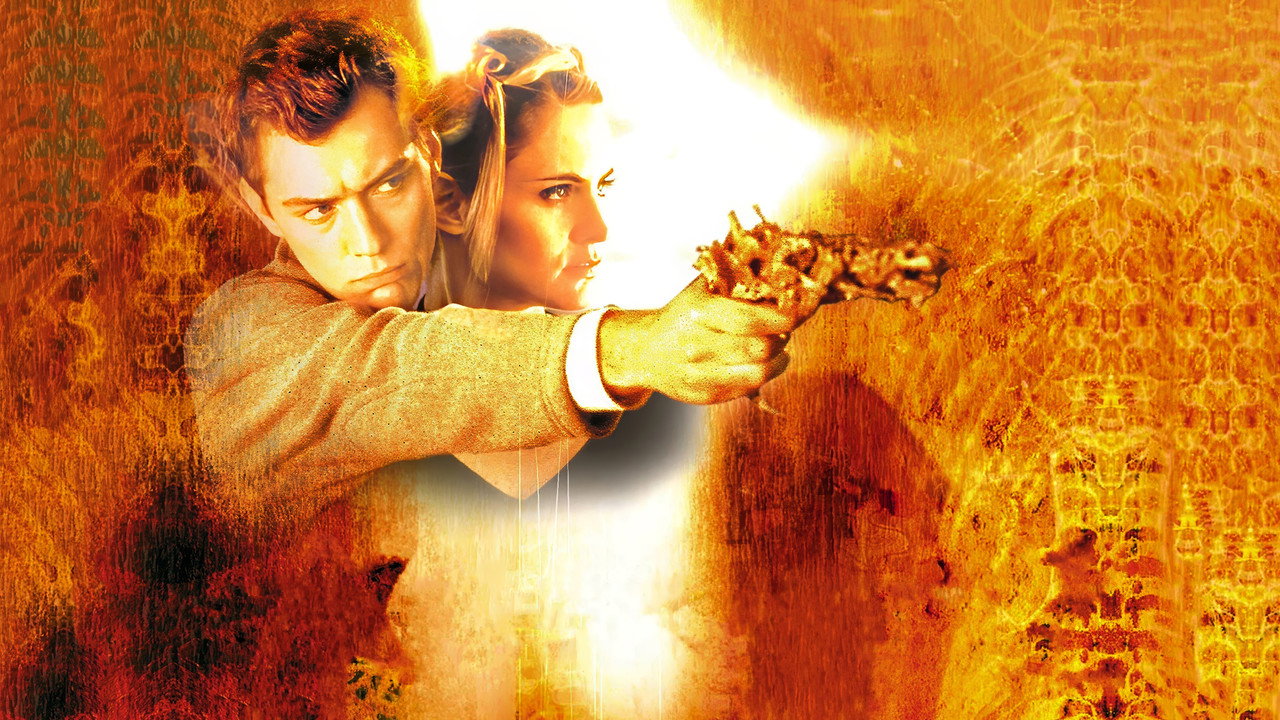
Allegra Geller, the world's greatest game designer, unveils her latest virtual reality system, eXistenZ, which connects directly to players' nervous systems through organic game pods. When an assassination attempt interrupts the launch, she escapes with a marketing trainee and they must play the game to determine whether it has been damaged — plunging into layered realities where neither they nor the audience can determine what is real.
Cronenberg's speculative technology is not digital but biological. The game pods in eXistenZ are grown from synthetic amphibian eggs, they connect to the player's spinal cord through an umbilical cord plugged into a surgically installed bioport, and they pulse in the player's hands like something between an organ and a pet. This is not an incidental design choice. Every virtual reality film that preceded eXistenZ — and several that followed it — imagined the interface as a screen, a visor, a clean separation between the user and the system. Cronenberg's interface is a wound. You do not observe the game from outside; you are penetrated by it, and it feeds on your nervous system, and the physiological boundary between your experience and the game's output is not a surface but a membrane, and membranes work in both directions. The technology is disgusting in the way that Cronenberg's technologies are always disgusting — not because they malfunction but because they function exactly as designed, and what they are designed to do is dissolve a distinction the user needed to keep. Ted Pikul's visceral discomfort at having a hole drilled into his spine is played as comedy and it is comedy, but the joke is precise: he objects to the violation of his bodily autonomy at the exact moment he is consenting to a violation of his epistemic autonomy that will prove far more difficult to reverse.
The game, once entered, introduces its own logic, and the logic is not declared. Ted and Allegra find themselves in environments that feel scripted — characters who repeat phrases until given the correct conversational trigger, objectives that emerge from actions rather than briefings, rules that can only be inferred by breaking them. Ted says it plainly: they are stumbling around in an unformed world whose rules and objectives are largely unknown, seemingly indecipherable or possibly nonexistent, always on the verge of being killed by forces they do not understand. This is presented as a description of the game and it is equally a description of what it feels like to operate inside any system of sufficient complexity — a large organisation, a regulatory environment, a legacy codebase — where the rules exist but were never documented, and the documentation that does exist describes a previous version that has since been patched in ways nobody recorded.
Cronenberg's subject, never named in the film but implied by every frame, is ontological debt: each layer of the game introduces assumptions that are not visible from within the layer, and those assumptions compound across layers in ways the players cannot audit. When Ted finds himself compulsively assembling a weapon from the bones of a mutant amphibian in a Chinese restaurant and shooting the waiter, he is horrified not because the act was violent but because he cannot determine whether the impulse was his or the game's. The distinction matters enormously to him and not at all to the outcome. The waiter is equally dead either way. Agency and automation have become indistinguishable at the interface, which is to say at the point where the user's nervous system meets the system's nervous system, and the meeting was physical from the start.
Allegra Geller designed the system, and the film does not let this protect her. She is the greatest game designer in the world, the game is her creation, and she enters it with the confidence of an author rereading her own novel. But the game responds to its players, incorporates their anxieties, and generates scenarios that neither author nor audience fully controls. Allegra needs to play the game to confirm that it survived an assassination attempt undamaged, and the test she is running is whether the game still works — but "works" means producing experiences that are indistinguishable from reality, which means she is evaluating the game's fidelity by a metric that, if the game succeeds, she cannot apply. A simulation that perfectly simulates cannot be assessed by the thing it simulates, because the assessor is inside the simulation and has no external reference point.
This is the product that consumes its users: not through addiction or manipulation, though both are present, but through a structural property of the medium. A game that is good enough renders the concept of "good enough" inaccessible from within the game. Allegra built a system so successful at modelling reality that reality can no longer function as a control. The anti-game faction that hunts her — the Realists, shouting death to the demoness — are positioned as fanatics for most of the film, but their analysis is structurally correct: the technology does dissolve the boundary between the real and the designed, and once dissolved, no diagnostic can restore it from within.
The film ends with the question — are we still in the game? — and refuses to answer it, and the refusal is the entire point. Cronenberg is not withholding resolution for dramatic effect. He is demonstrating that the question is unanswerable by design, because the conditions that would allow you to answer it are the conditions the game is designed to replicate. Every organisation that has built a product on top of a platform on top of an infrastructure layer on top of a set of dependencies whose original design assumptions nobody alive remembers has incurred this debt and is paying it in the same currency: the inability to determine, when something goes wrong, which layer the wrongness lives in, and whether the wrongness is a bug or a feature that was designed into a layer nobody can see.