パプリカ
Writers: Satoshi Kon (screenplay), Seishi Minakami (screenplay), Yasutaka Tsutsui (novel)
Cast: Megumi Hayashibara, Toru Furuya, Koichi Yamadera, Katsunosuke Hori, Akio Otsuka
Dr. Atsuko Chiba has developed the DC Mini, a device that allows therapists to enter and observe patients' dreams. When three of the prototypes are stolen before safety protocols are finalised, dreams begin leaking into waking reality — first as hallucinations, then as full-scale invasions. A carnival parade of household objects, religious statues, and kitchen appliances marches through Tokyo, rewriting the physical world in the logic of the unconscious. Dr. Chiba and her dream-world alter ego Paprika must find the thief before the boundary between dreaming and waking dissolves entirely.
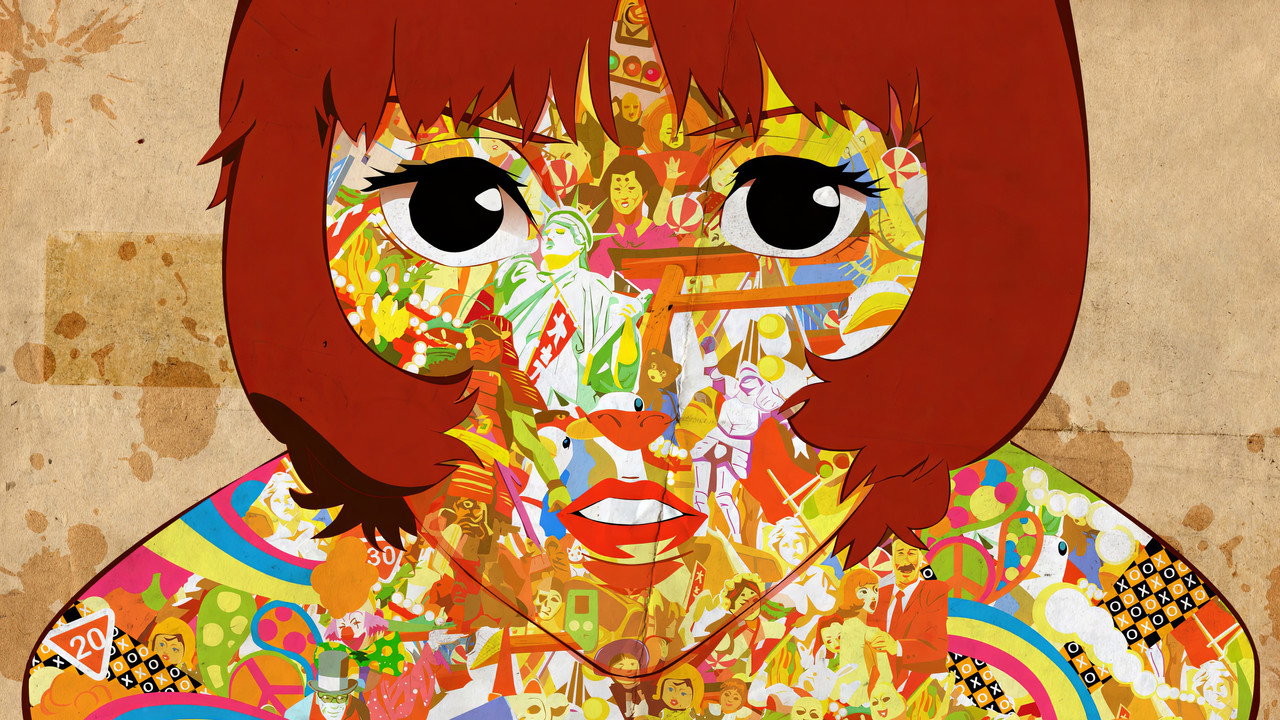
The parade is the image that stays. A procession of refrigerators, Shinto gates, tin dolls, daruma figures, brass bands, and household gods marches through Tokyo with the formal logic of a religious festival, and the streets make way. It does not attack; it absorbs. Cars, buildings, people, the physical grammar of the waking city are folded into the procession and become participants, and the procession has no destination, no purpose, no demand. It simply grows. Satoshi Kon animated this sequence with the fluency that characterised all of his work — the transition from dream-world to waking-world happens inside a single pan, the way a system crosses a boundary condition: not with a rupture but with a continuity so smooth that no one notices the regime change until the old rules no longer hold. The parade is scope creep made visible. It is what happens when a contained process is released without its constraints, and it turns out the process had been accumulating material for a long time.
The DC Mini is the device at the centre of the story, and its design problem is immediately recognisable. It was built to allow a therapist to enter a patient's dream, observe the contents, and use that observation as a diagnostic instrument. The interface was meant to be one-directional: the therapist goes in, takes notes, comes out. What the stolen prototypes reveal is that the interface was never one-directional. The dreams flow both ways. Patients' unconscious imagery leaks into the therapist's waking life; the therapist's expectations reshape the dream; and when the DC Mini is operated without the safety protocols that were still being developed, the boundary between the two systems dissolves completely.
Kon was making a film about dreams and psychotherapy, but the structure he described is the structure of any system where a model is built to observe another system and the act of observation changes both. The financial model that, by existing, changes the behaviour of the market it models. The user-research operation that, by asking questions, alters the product expectations it is trying to measure. The monitoring dashboard that becomes the thing the team optimises for. Every one of these is a boundary dissolution, and the distinguishing feature is the one Kon dramatises: nobody notices until the parade is already in the street.
Chairman Inui, the antagonist, is the organisational figure the film needs and almost does not deserve, because Kon gives him motives that are more interesting than villainy. Inui is old, confined to a wheelchair, and furious at the DC Mini's development not because it threatens public safety but because it represents a world he cannot enter. His objection is procedural — the device was not approved, the trials were not completed, the risks were not assessed — and every one of his objections is correct. The irony is that Inui's procedural correctness conceals a private ambition of total control: he wants the device for himself, not to observe dreams but to colonise them, to impose his own order on the ungovernable territory of the unconscious. Science is nothing but a piece of trash before a profound dream, he says, and the line works simultaneously as mysticism and as the logic of a certain kind of executive who believes that the subjective, the unquantified, the not-yet-measured is more real than any instrument, and who therefore wants not to eliminate subjectivity but to monopolise it. He is the regulator who becomes the worst-case scenario his own regulations were designed to prevent, and the film treats this not as hypocrisy but as a structural inevitability: the person closest to the boundary is the person most likely to cross it.
Dr. Chiba's other self, Paprika, is the film's answer to a question that most interface-design discourse avoids. Who is the user inside the system? When Chiba enters a dream, she does not appear as herself; she appears as Paprika, a younger, freer, more fluid version of her own personality — an avatar in the precise sense, a projection optimised for operating in a different environment. Paprika can do things Chiba cannot: move between dreams, talk to the parade, negotiate with the unconscious imagery on its own terms. But Paprika is not a mask; she is a genuine aspect of Chiba that only exists inside the system, and as the boundary dissolves she begins to exist outside it too, which means that the tool has changed the user, permanently, in ways the user did not design and cannot reverse. By the end of the film Chiba and Paprika are not separate. They are integrated, and the integration is presented not as a loss but as a completion — the recognition that operating inside a complex system for long enough changes the operator, and that the changed operator is not a corrupted version of the original but a version that has incorporated what the system taught her. Kon died in 2010, at forty-six, with several films unmade, and this was his last completed feature. What he left in it was a thesis about interfaces that remains more precise than most of what has been written on the subject since: that the boundary between the observer and the observed is a design decision, not a natural law, and when the design fails, what emerges is not chaos but a deeper order that neither side controlled and neither side can fully claim. The parade has no destination, but it has a logic, and the logic is that everything, eventually, joins.