Кин-дза-дза!
Writers: Georgiy Daneliya (screenplay), Revaz Gabriadze (screenplay)
Cast: Stanislav Lyubshin, Evgeny Leonov, Yuri Yakovlev, Levan Gabriadze
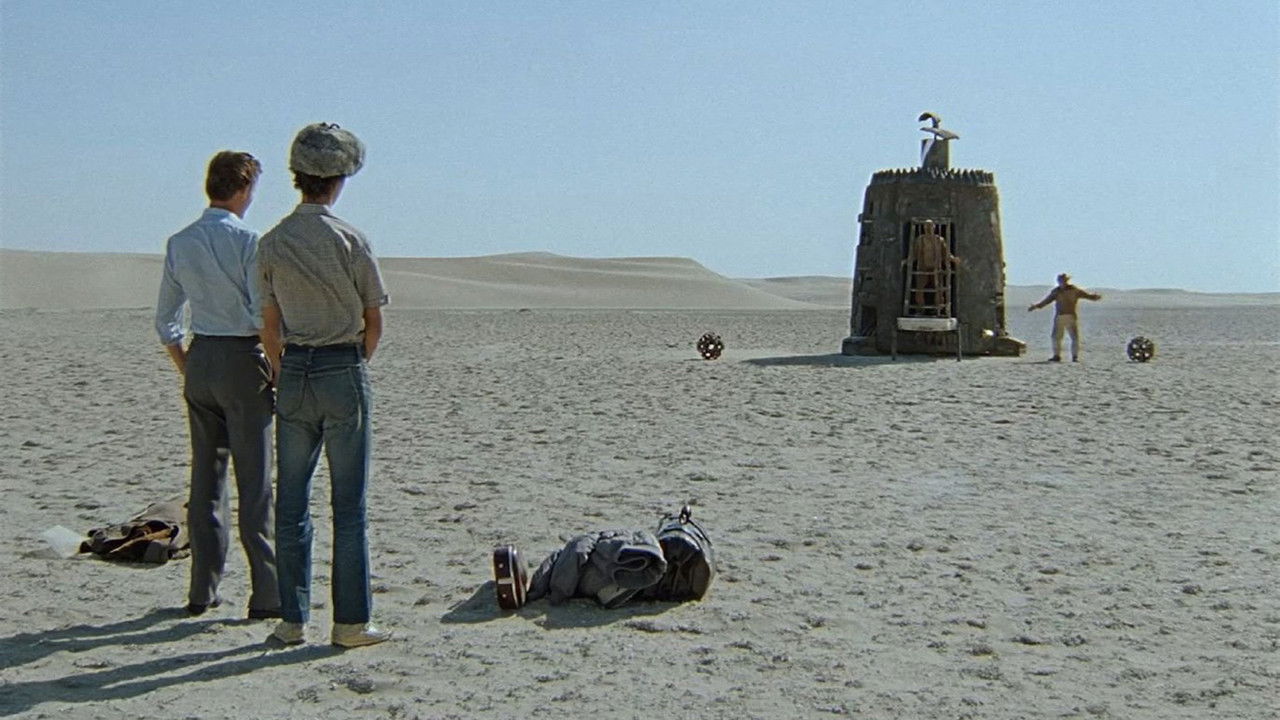
Vladimir Mashkov, a Moscow construction foreman, and Gedevan Alexidze, a Georgian student carrying a violin, stop on the street to help a barefoot stranger who claims to be an alien. They press a button on his device and find themselves in a desert on Plyuk, a planet in the Kin-dza-dza galaxy where society runs on two words, matches are the only currency, and the colour of your trousers determines who must squat before whom. Stranded and increasingly complicit, the two men try to negotiate their way home through a bureaucracy whose rules they learn to obey long before they understand them.
The civilisation of Plyuk speaks two words. Ku means everything; kyu is the single obscenity. Everything else — commerce, courtship, law, threat, apology — is carried by those two syllables plus tone, gesture and the colour of your trousers. Georgiy Daneliya took the Sapir-Whorf hypothesis, the idea that the language available to you sets the boundaries of what you can think, and played it as desert farce. The result is a proposition stated with unusual economy: a society whose vocabulary has two words has two modes. There is nothing to say that the language does not already permit, so nothing gets said that the arrangement does not already allow. The people of Plyuk are not stupid. They are fluent. That is the problem.
The hierarchy is enforced by two objects. Trouser colour — yellow, then raspberry — establishes how many times an inferior must squat in your presence, and status is bought with matches, the planet's only currency. The tsak, a small bell, is clamped to the nose of every Patsak so that no encounter can occur without the caste being visible first. What makes the film uncomfortable rather than merely funny is not the invention but the speed of the adaptation. Mashkov, a Moscow foreman, and Gedevan, a student with a violin, spend perhaps an hour of screen time protesting that the whole thing is absurd, and the rest of the film performing it — squatting, wearing the bell, calculating how many matches a life is worth, learning to distinguish orange from green because getting it wrong is dangerous. They do not accept the hierarchy intellectually. They operate inside it, which is a different and more durable kind of consent. Anyone who has watched a reasonable person defend a process they privately consider ridiculous has seen the same mechanism at work.
In the post-Soviet world the film did something few satires manage: its invented vocabulary escaped into ordinary speech. Ku entered everyday Russian roughly the way catch-22 entered English — as a word for something that had been widely experienced but had no name. It came to mean performative compliance with authority known to be absurd, the squat you perform while thinking clearly about why you are performing it. Daneliya did not describe a bureaucratic pathology; he built a working notation for it, and the notation was adopted. There is an irony worth sitting with. A film about a language too impoverished to permit dissent supplied its own audience with the missing word.
Outside the former Soviet Union it remains close to unknown, and that fact is part of the subject. The most penetrating satire of institutional absurdity produced in the twentieth century circulated inside a closed cultural ecosystem, which is also the ecosystem that made it legible. Its most reliable joke — ecilop, the word for the authorities, is police spelled backwards — depends on a reader who already understands that official language works by inversion. There is no Western equivalent, not because nobody attempted one, but because the conditions that produced Plyuk were local. Watching it now, from an industry that generates its own compulsory rituals and its own tolerated nonsense-words, the film reads less like a period document than like a set of instruments calibrated on a system we no longer have, still perfectly capable of taking a reading on ours.