The Great Dictator
Writers: Charlie Chaplin (screenplay)
Cast: Charlie Chaplin, Paulette Goddard, Jack Oakie, Reginald Gardiner, Henry Daniell, Billy Gilbert
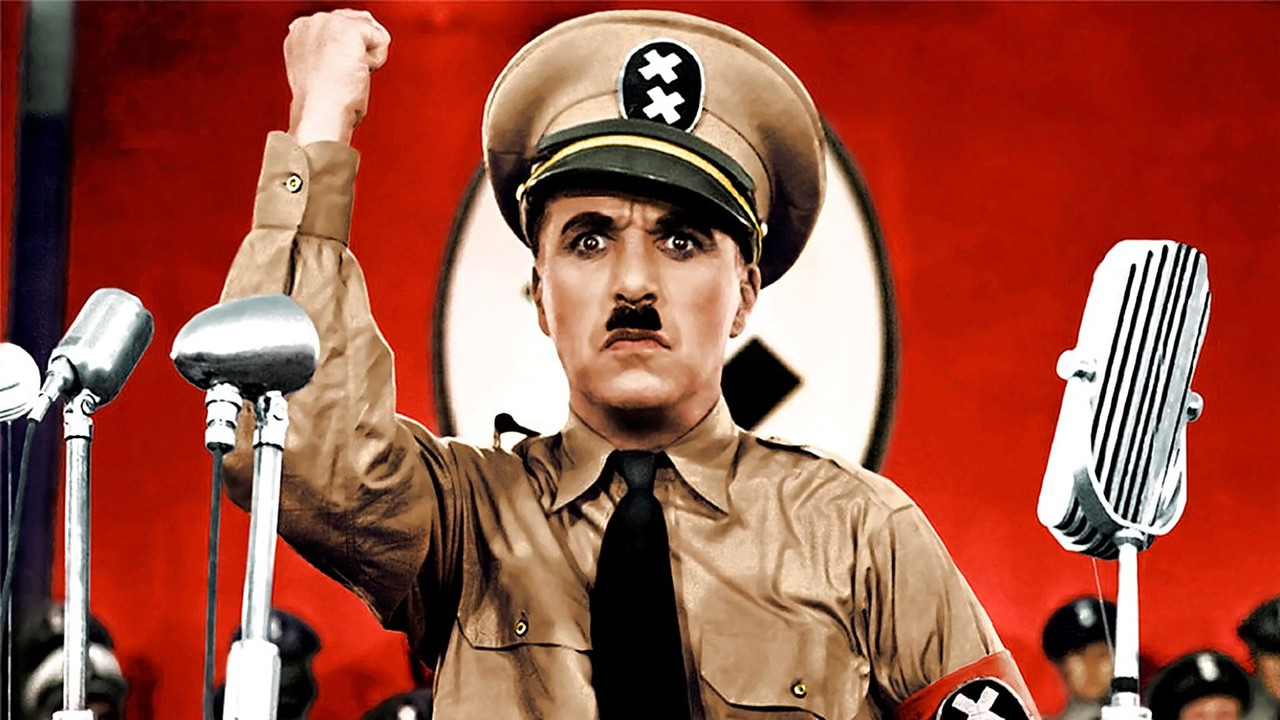
Chaplin plays two men who happen to look identical: Adenoid Hynkel, dictator of Tomainia, and a Jewish barber who has spent twenty years in a hospital with amnesia after the First World War and returns to a ghetto he does not understand has changed. The barber is persecuted by Hynkel's stormtroopers; Hynkel plans the invasion of Osterlich while dancing with an inflatable globe. The two plots converge when the barber is mistaken for the dictator and finds himself standing at a microphone in front of a nation, expected to deliver a speech about conquest.
The resemblance that makes the film possible was not invented by Chaplin. Hitler was born four days after him, in the same spring of 1889, and by the early thirties had adopted a toothbrush moustache that the most recognisable face on earth had been wearing since 1914. Chaplin noticed, and what he built on the coincidence is stranger than a joke about lookalikes. The dual role is a thesis about the medium both men were using. Chaplin became globally legible by inventing a silhouette that needed no language; Hitler became nationally irresistible by mastering the radio address and the newsreel rally. Neither achievement depended on the content of what was communicated. Both depended on repetition, image discipline and a distribution network that had not existed a generation earlier. When the barber and the dictator turn out to be interchangeable — when the state's entire apparatus of recognition can be satisfied by a man who happens to have the right face and the right moustache — the film is making a claim about mass media rather than about politics. The medium authenticates the speaker by appearance, and the message rides on whoever occupies the frame.
Hynkel's speeches are the proof. Chaplin, who had resisted sound for a decade and whose Tramp had never spoken, uses his first talking picture to deliver several minutes of invented German: pure cadence, glottal aggression, sudden tenderness, the microphone physically recoiling from the shouting while an interpreter renders long tirades as bland summaries. There is no content at all. That is the point, and it is a technical observation about broadcast persuasion. What travels through a loudspeaker to a crowd is rhythm, volume and conviction; the argument, if there is one, is inferred by the listener afterwards. Anyone who has watched a keynote land on the strength of its staging and its confidence, and then tried to reconstruct what was actually claimed, has heard the Hynkel speech. The film is not saying that audiences are stupid. It is saying that the channel selects for the properties it can carry, and that a medium optimised for emotional bandwidth will reward whoever supplies emotion most efficiently, regardless of whether anything is being said.
Then the barber reaches the microphone, and Chaplin does something no filmmaker with his commercial position had reason to do: he abandons the picture. The character has no speech to give, so the man gives his own — six minutes to camera, in Chaplin's own voice, addressed past the fictional crowd to the audience in the cinema. The double is broken, the satire is broken, the comedy is broken. He asks the soldiers not to give themselves to brutes, tells the people the power is theirs, and says that we have developed speed and shut ourselves in, that machinery which gives abundance has left us in want, that we think too much and feel too little. Critics have complained ever since that the speech is sentimental and that it ruptures the film, and both charges are true. It also became, in a sense that had no name in 1940, the first viral speech of the cinema age: reprinted in newspapers, broadcast on radio, recirculated for eight decades, set to music, cut over montages, quoted by people who have never seen the film it destroys. The rupture is why it travelled. A perfectly sealed satire would have stayed inside its own frame; the speech works precisely because it stops performing and starts addressing.
What makes the film worth returning to is the position from which it was made. In 1940 the United States was neutral, the studios were avoiding Nazi subjects to protect European distribution, and the British censor had signalled that a film ridiculing Hitler would not pass. Chaplin financed it himself, spoke for the first time in order to make it, and released it with the outcome of the war entirely undetermined — acting on incomplete information, at real commercial and political risk, before the consensus arrived to make the position safe. He later wrote that had he known the actual extent of the camps he could not have made comedy of any of it, which is an honest recognition that his instrument was adequate to the target he could see in 1939 and not to the one that became visible in 1945. Both halves matter. Speaking early means speaking with a model that will turn out to be incomplete, and waiting for a complete model means speaking after it no longer costs anything. Chaplin chose the first, and the film carries the marks of that choice — uneven, tonally unstable, ending in a plea rather than a punchline, and correct.