THX 1138
Writers: George Lucas (screenplay), Walter Murch (screenplay)
Cast: Robert Duvall, Donald Pleasence, Don Pedro Colley, Maggie McOmie
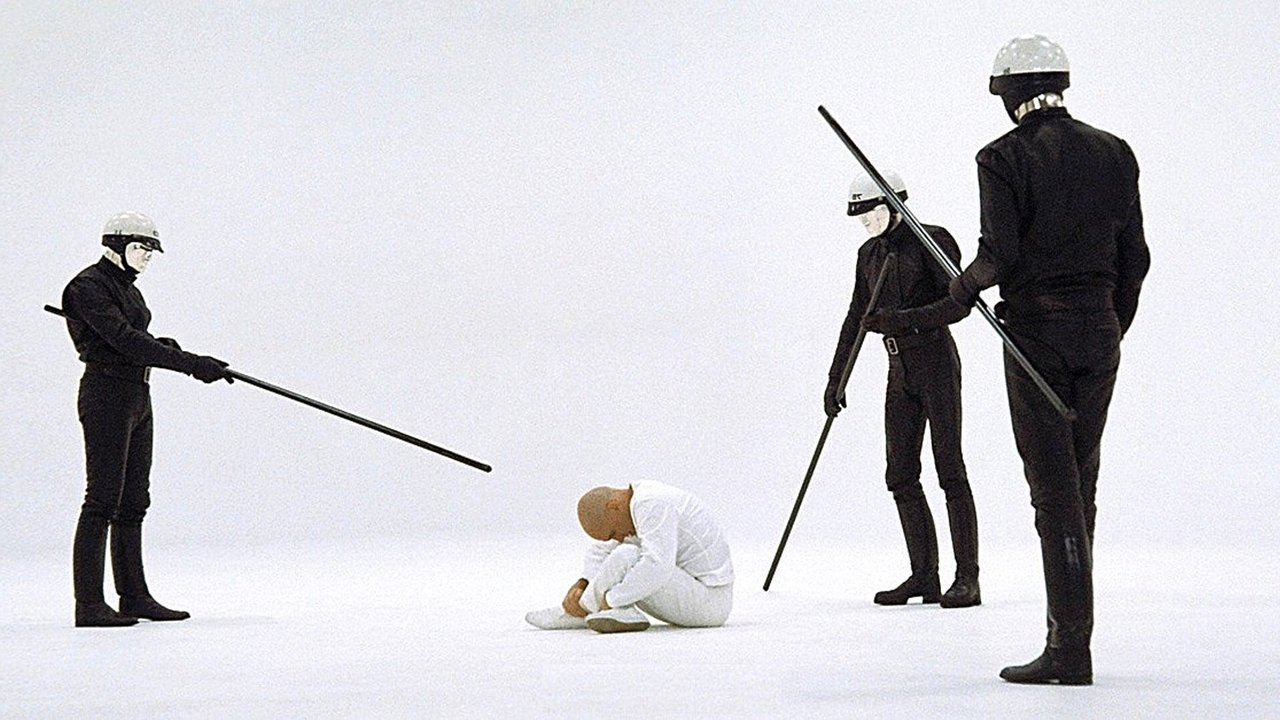
In a sealed underground city of the future, citizens are kept docile through mandatory sedation, monitored by cameras and android police, and directed to consume. THX 1138, a factory worker, stops taking his medication when his roommate LUH secretly alters his dosage. Feeling for the first time, he tries to escape, and the state deploys its chrome-faced police to retrieve him. They pursue him through tunnels and shafts toward the surface — until the cost of the pursuit exceeds the allocated budget, and they stop.
George Lucas made this film in 1971, before Star Wars, before Industrial Light & Magic, before merchandising became his real product — and the fact that the same person made THX 1138 and then built one of the most vertically integrated entertainment corporations on earth is a tension worth holding, not because it is ironic but because it is instructive. The underground city in this film is not governed by a dictator, an ideology, or a military junta. It is governed by administration. Citizens are sedated because sedation reduces error rates. They are surveilled because surveillance reduces deviation. They consume because consumption is the purpose the system has assigned them, and the system is not being cynical — it genuinely provides for its inhabitants, feeds them, houses them, entertains them, and handles their spiritual needs through OMM, a warm recorded voice that blesses them with the blessings of the state and the masses in the same cadence a helpdesk uses to tell you your call is important. The genius of the film is that it never shows anyone in charge. There are controllers in white rooms monitoring screens, and android police enforcing compliance, and confessional booths dispensing absolution, but none of these are the authority. They are functions. The authority is the system itself — the sum of its processes — and it does not need to be conscious to be total.
The white void is the film's most lasting image, and it works because Lucas understood something about institutional space that most filmmakers miss. THX's world is not dark, not cluttered, not oppressive in the way cinema usually codes oppression. It is bright, clean, featureless — an infinite white floor under an infinite white ceiling, with no walls, no corners, no landmarks. This is the space of pure process: nothing to orient by, nothing to push against, nothing to hide behind, no feature that would give a person standing in it a reason to walk in one direction rather than another. It is the architectural expression of a system that has removed all friction, including the friction that gives movement a purpose. Lucas shot Robert Duvall and the other prisoners wandering through this space, and the effect is worse than a dungeon would be, because a dungeon implies an architect with intentions — someone locked you in, and someone might let you out. The white void implies nothing. It is not designed to punish. It is simply a space in which no decision can be made, because there is nothing to decide between. Any organisation that has ever flattened its hierarchy completely, removed all ownership, dissolved every boundary in the name of openness and transparency, and then watched its people wander in circles looking for a wall to push against, has built a small version of that room.
But the ending is the thing. THX breaks free, finds a shaft, climbs toward the surface, and the chrome-faced android police follow him — smoothly, persistently, without anger or urgency, because they are incapable of both. They close on him as he ascends. And then, in a control room somewhere below, a voice reports that the cost of the pursuit has exceeded the budget. The operation is over budget by six percent, then nine, then more. The police are recalled. They turn around, mid-pursuit, and walk back underground. THX climbs out into sunlight — a red disc of sun on the horizon, the first natural light in the film — and stands there, free, not because he outran the system or outsmarted it or destroyed it, but because his recapture was not cost-effective. The system did the arithmetic and decided he was not worth the expenditure.
This is not mercy and it is not failure. It is accounting. The totalitarian state has a budget, and the budget is the actual boundary of its power. Lucas understood at twenty-seven what most dystopian fiction still has not caught up with: that the limiting factor of modern control is not cruelty or ideology but resources, and that the question every system asks about a deviation is not "is this wrong" but "what does it cost to correct." A surveillance state that can see everything still has to decide what it is willing to spend to act on what it sees, and that decision is made in a spreadsheet, by someone — or something — comparing the value of a recovered citizen against the operating cost of the units deployed to recover him. THX is free because his row in the ledger went negative.
There is a reading of this that is optimistic — the system has limits, the individual can escape, the sun is real and the surface exists. Lucas shoots it that way, with the warmth of the closing image and the Lalo Schifrin score opening out after eighty minutes of electronic hum. But the optimism is conditional, and the condition is worth naming. The system is still down there, still sedating, still surveilling, still running — and the next THX who tries will be evaluated against the same line item, and if the budget has expanded or the cost of android police has fallen, the pursuit will not stop at the shaft. Anyone who has ever been the project a company decided not to fight for — not because it was wrong, but because the resources could be deployed more efficiently elsewhere — has been THX climbing into the sunlight, free and worth exactly nothing.