Der Himmel über Berlin
Writers: Wim Wenders (screenplay), Peter Handke (screenplay), Richard Reitinger (screenplay)
Cast: Bruno Ganz, Solveig Dommartin, Otto Sander, Curt Bois, Peter Falk
Two angels, Damiel and Cassiel, drift through Cold War Berlin listening to the inner thoughts of the city's inhabitants — their fears, regrets, small calculations, and griefs. They can observe everything and alter nothing. When Damiel falls in love with a trapeze artist and chooses to become mortal, he trades omniscience for a cup of coffee, the feeling of cold, and the ability to say 'now' instead of 'forever.'
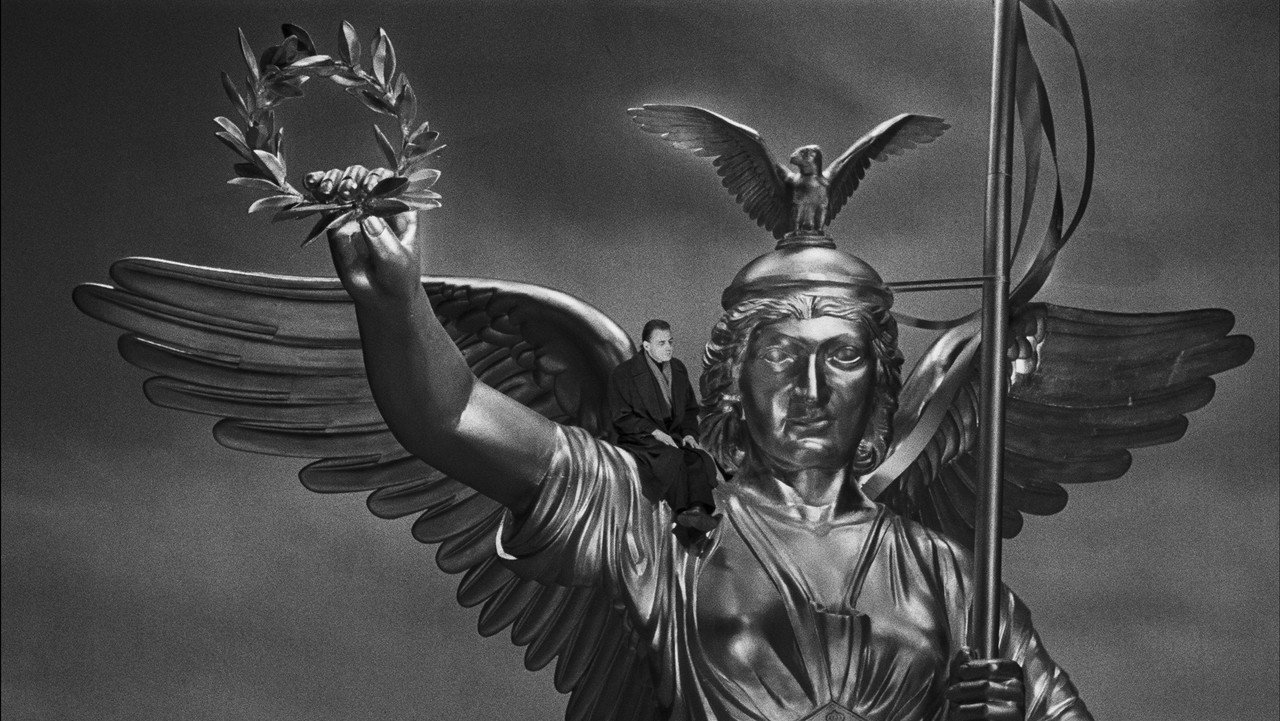
Damiel and Cassiel drift through Berlin in 1987. The Wall is still standing. The city is full of people thinking — not talking, thinking — and the two angels can hear every one of them. They sit in the Staatsbibliothek and the interior monologue of every reader in the room arrives simultaneously: a student worrying about money, an old man remembering a street that no longer exists, a woman composing a letter she will never send. The angels receive everything and can do nothing with it. They can comfort, in a way — a hand on a shoulder produces a slight easing of despair, a shift in mood the person will attribute to nothing. But they cannot speak, cannot be heard, cannot make themselves known. They are, in the most precise sense of the word, observers. And Wenders films them in monochrome, because that is what the world looks like to a being with infinite bandwidth and zero agency: complete, grey, and unalterable.
This is where the film becomes interesting for anyone who has ever stared at a dashboard. The angels' position is structurally identical to that of a system monitor with read-only access. They have perfect telemetry. Every signal arrives in real time. They can see the whole city, know what every node is doing, track the inner state of each component with a fidelity no instrument could match. And they are completely helpless. Their knowledge is total, and it is useless — not because the information is wrong, but because information without the capacity to act on it is not understanding. It is surveillance. It is watching someone drown and being able to record the exact moment they go under. Damiel has been doing this for a very long time, possibly since time began, and the film's central event is the moment he decides to stop.
What he wants is not knowledge. He already has all the knowledge. What he wants is limitation. He says it himself: he wants a history of his own, a weight to end the infinity and tie him to earth, the ability to say "now" instead of "forever." This is the film's deepest and least obvious claim — that constraint is not the enemy of experience but its precondition. Mortality, hunger, cold, the inability to see around the corner: these are not deficiencies that an angel would rightly be glad to lack. They are the conditions under which anything can matter. A cup of coffee matters because you are cold. A conversation matters because you will die. A decision matters because you cannot take it back. Remove those constraints and you have not gained freedom; you have gained eternity, which is to say you have gained a position from which nothing is at stake and therefore nothing is important. Peter Falk, playing himself on a film set in Berlin, describes the mortal state with a precision that makes Damiel's choice intelligible. To smoke, and have coffee — and if you do it together, it is fantastic. That is not a trivial statement. It is a description of what sensory experience is like when your time is finite and your body is the only instrument you have.
The choice Damiel makes, to fall, to accept the body, to become a participant, is the choice every system observer eventually faces. You can watch the metrics, read the logs, attend the standups, review the dashboards, and know, in a comprehensive and ultimately sterile way, what is happening. Or you can build something, ship something, commit to a decision that forecloses other decisions, and accept that the moment you do so you will lose the vantage point from which everything was visible and nothing was at risk. There is no middle position. This is what the film stages with its colour shift: the moment Damiel becomes mortal, the screen floods with colour for the first time. He bleeds. He tastes coffee. He discovers that the sky is blue — actually blue, not the monochrome of angelic perception — and the discovery matters because it cost him something. He knows now what no angel knows. The line is the film's thesis, and it is also the answer to a question that every person who has ever sat in a review meeting and asked "why didn't you see this coming?" has inadvertently posed: they saw it coming. Seeing it coming is easy. The hard part is being somewhere specific, at a time that will not come again, with limited information and a body that gets cold, and choosing anyway. It is the standing inside — the skin, the cold, the coffee, the irreversible now — that turns observation into knowledge.