The Right Stuff
Writers: Philip Kaufman (screenplay), Tom Wolfe (book)
Cast: Sam Shepard, Scott Glenn, Ed Harris, Dennis Quaid, Fred Ward, Barbara Hershey, Lance Henriksen, Veronica Cartwright
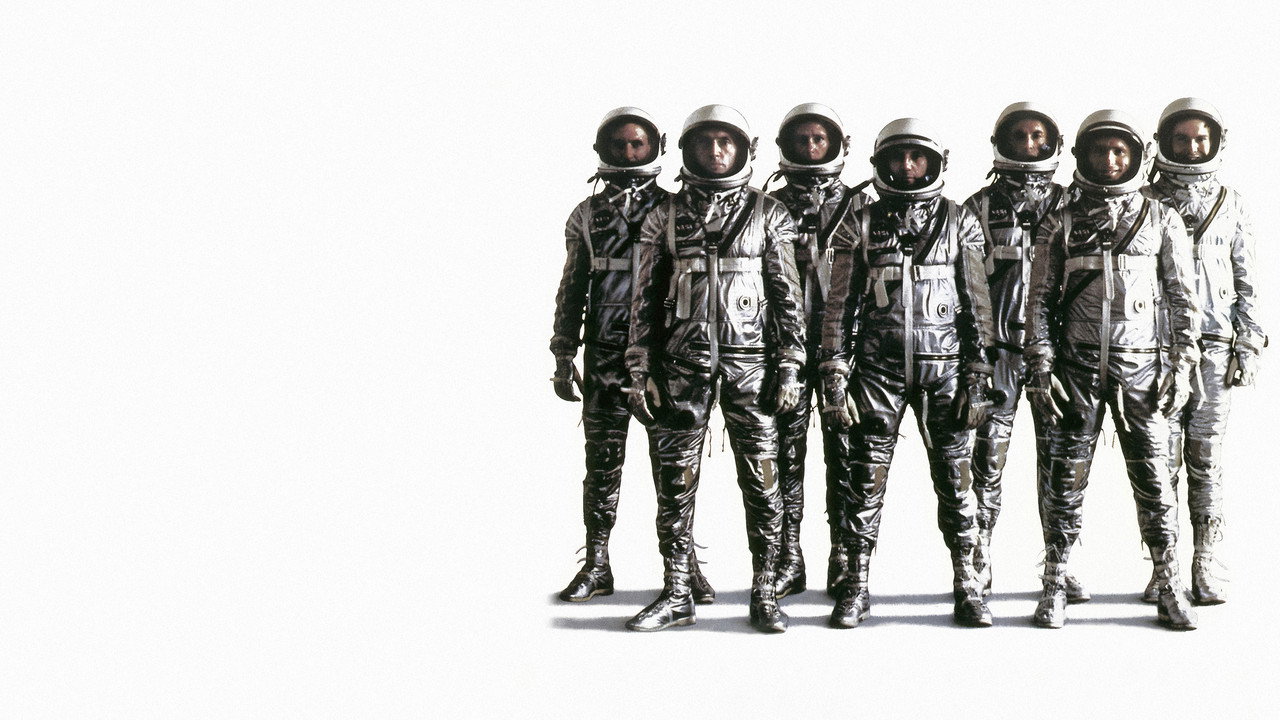
From Chuck Yeager breaking the sound barrier in 1947 to the final Mercury mission in 1963, the film follows two parallel tracks: Yeager, the greatest pilot of his generation, testing aircraft alone in the desert; and the Mercury Seven, military pilots selected, tested, and trained to ride a capsule into space. The astronauts are celebrated as heroes, but their struggle within NASA is to be treated as pilots rather than passengers — to have a window, a hatch they can open, a control they can override. Yeager, who could outfly any of them, is excluded from the programme because he lacks a college degree.
The first design decision an organisation makes is who it lets in. Everything else follows from that — the culture, the vocabulary, the fights, the things that never get built because nobody in the room knows to ask for them. Philip Kaufman's film is, among other things, a three-hour study of this principle, structured around a single exclusion that shapes everything. Chuck Yeager broke the sound barrier in 1947, in a plane with a cracked rib that he did not report because reporting it would have grounded him. He was, by every measure available to the profession, the best pilot alive. When NASA began selecting astronauts for the Mercury programme in the late 1950s, the requirements specified a college degree. Yeager did not have one. He was never considered. Sam Shepard plays him as a figure who exists outside the frame of the institution, still flying in the desert, still testing aircraft that kill other men, still pushing against the edge of what is known — and the film keeps cutting back to him not to say that NASA was wrong, exactly, but to say that the organisation's first filter determined its character, and that character had consequences it could not see from inside itself. The Mercury Seven were all fine pilots. But the best pilot was in the desert, excluded by a credential, and the programme built itself around the men who passed a gate he could not enter.
The central fight inside the programme is not about courage or endurance but about what kind of role the astronaut is. The engineers see the Mercury capsule as an automated system — a ballistic object with life support, controlled from the ground, containing a human being whose function is to be monitored and to report physiological readings. The capsule has no window, no manual override, no hatch the occupant can open from inside. The astronaut, in the engineers' design, is a biological sensor package: he rides the system; he does not fly it. The pilots see this differently, and Kaufman gives the fight its full weight. Their professional identity rests on the premise that what they do cannot be reduced to what a machine does. What makes a pilot a pilot and not a passenger is judgment under conditions the system did not anticipate — the ability to feel something through the controls that the telemetry does not capture. They demand a window. They demand a hatch they can blow. They demand a manual override they can grab if the automated system fails. And they get these things, not because the engineers are convinced, but because the astronauts threaten to go to the press, and the programme needs the press. This is the permanent negotiation between the person who does the work and the organisation that designs the system the work is done inside of. The film's sympathy is clearly with the pilots, but its honesty is in showing that the engineers were not entirely wrong. The capsule was, in fact, largely automated. The astronauts were, in fact, passengers for most of the flight. The tacit knowledge mattered at the margins, in the moments when the system failed or the unexpected happened. The question the film poses is whether an organisation can afford to design for the margins, or whether it must design for the centre and hope the margins take care of themselves.
The phrase "the right stuff" is Tom Wolfe's, and Kaufman is careful never to define it, because the whole point is that it resists definition. It is the thing the test pilots recognise in each other and cannot articulate — the quality that lets one man walk away from a crash that killed another, the capacity to perform at the edge of the envelope where the aircraft is doing things its designers said it would not do. It is, in the language of craft, tacit knowledge at its most extreme: the thing that cannot be taught, tested, written into a procedure, or captured in a metric, but whose absence is immediately legible to anyone who has the thing themselves.
The film's most cutting scene is the one where the Mercury candidates are subjected to medical tests — probed, scanned, exercised, bled, x-rayed, and asked to provide samples into containers — in a long, humiliating montage that reduces the body to data. The doctors are looking for the right stuff in the only way an institution can look for it: by measuring what is measurable. They measure reaction time, heart rate, stress tolerance, centrifuge endurance, and none of these are the thing. The thing is what happens when all the measurable parameters are inside tolerance and the pilot still has to decide, with a feel he cannot explain, whether to push through or pull out. Cooper's line — the issue here is monkey — captures the astronauts' whole objection in five words: the programme's tests cannot distinguish between a test pilot and a chimpanzee, and if the role does not require the distinction, then the role has been designed wrong.
Yeager's last flight in the film — the NF-104, a rocket-assisted aircraft that he takes to the edge of the atmosphere until it spins out and he falls, on fire, toward the desert floor — is the counterargument the organisation never hears. He is doing something the programme did not ask for, in a vehicle nobody ordered him to fly, at an altitude that exceeds the specification, and when the aircraft fails he survives through precisely the tacit, unquantifiable, bodily knowledge the Mercury programme's designers did not believe was the relevant variable. He walks out of the desert, burned, holding his helmet, and the film does not say he was right to fly. It says that the thing he has — the thing the programme was named after — is not the thing the programme selected for, and that an organisation's admission criteria are also its blindness criteria, determining not only who gets in but what the organisation will never learn from the people it excluded. No bucks, no Buck Rogers, Grissom says, and the line is funny and true: funding makes the bird go up, and the funders require credentials.