12 Angry Men
Writers: Reginald Rose (screenplay)
Cast: Henry Fonda, Lee J. Cobb, Ed Begley, E.G. Marshall, Jack Warden, Martin Balsam, John Fiedler, Jack Klugman, Robert Webber, Joseph Sweeney
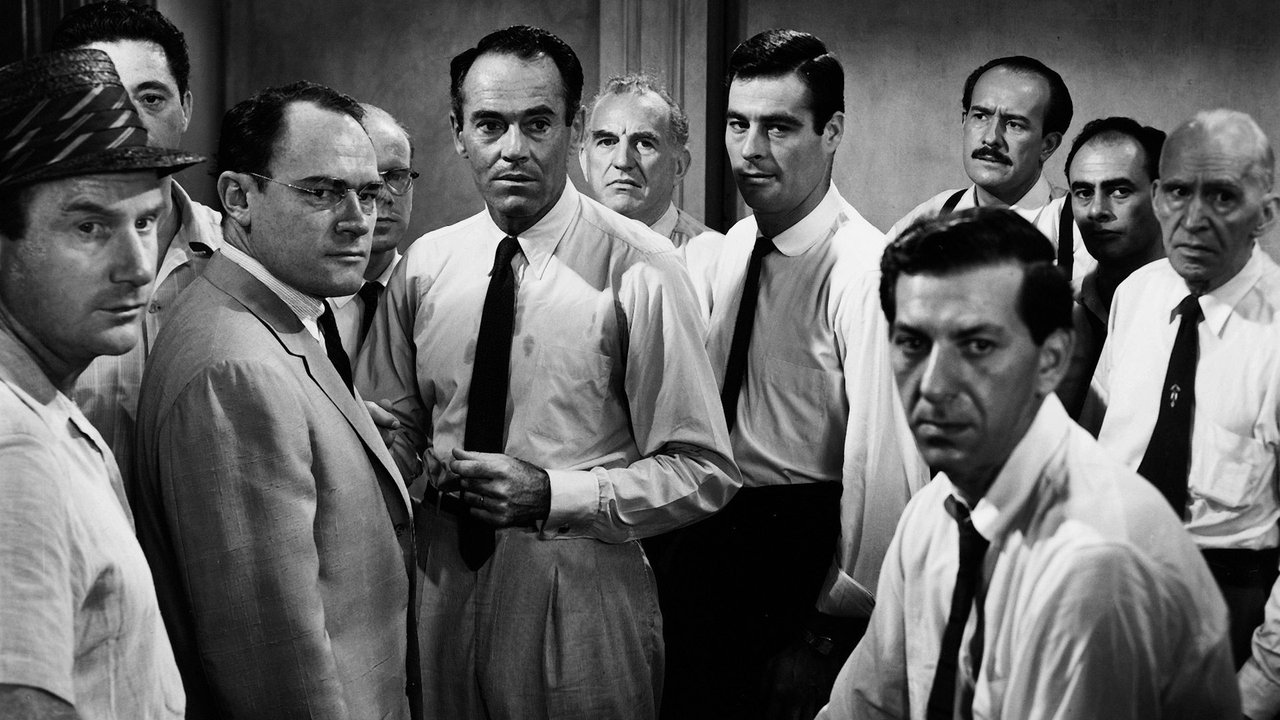
A jury of twelve men deliberates the fate of a young defendant charged with murdering his father. The initial vote is 11–1 for conviction. The lone dissenter, Juror #8, does not argue the boy's innocence — he argues that the evidence has not been examined. Over ninety minutes of real time, in a single room on the hottest day of the year, the vote turns, and the film becomes a precise study of how a group changes its mind.
The remarkable thing about Juror #8 is how little he actually claims. He never says the boy is innocent; asked directly, he admits he does not know. He has no counter-evidence, no alternative theory, no witness of his own. What he has is a set of questions the group has not asked, and a single procedural objection: that eleven men reached a verdict in five minutes on a matter that will end in an execution. It's not easy to raise my hand and send a boy off to die without talking about it first. That is not an argument about the case. It is an argument about the process, and the distinction is the whole film. He is not the defence counsel the boy never really had; he is something rarer and more useful, a person who declines to ratify a decision until the group has done the work it was formally convened to do. Anyone who has sat in a room where a decision arrived pre-made will recognise the move and how unpopular it is. The dissent is not you are wrong. It is we have not looked. Supposing they're wrong? costs nothing to say and is almost impossible to answer, which is precisely why so few people say it.
What turns is not conviction but the price of dissent. The first ballot is often read as a measurement of what eleven men believed; it is nothing of the kind. It is a measurement of what eleven men were willing to say out loud in a hot room at the end of a long week, with a colleague announcing that he has three garages going to pot and a ball game to get to. Several of those votes were never beliefs at all. They were the cheapest available exit. Juror #8 does not change anyone's mind so much as he changes the arithmetic: by absorbing the full social cost of being the one who delays everybody, he makes the second dissent cost almost nothing, and the third less than that. The cascade that follows is not a chain of persuasions but a sequence of permissions. Juror #11's fury at the man who flips his vote to leave early — who tells you that you have the right to play like this with a man's life? — is aimed at exactly this: the vote was never an opinion, and now that it is free to change, its emptiness is visible. A first vote in any group measures pressure before it measures judgement.
The other thing the film is honest about is that none of these men are reasoning about the case. Juror #10's certainty rests entirely on what he thinks people from the boy's neighbourhood are like; he says so plainly, and hears nothing wrong in it. Juror #3's conviction is a wound about his own son, who hit him in the jaw at sixteen and whom he has not seen in two years — a fact that has no bearing on the evidence and determines his vote completely. Juror #7 wants baseball. Juror #12 wants to be agreeable. What Reginald Rose declines to do is moralise about any of it. There is no scene in which prejudice is denounced and defeated; there is a scene in which the other jurors simply turn their chairs away from Juror #10 and let him finish talking to nobody. The film's claim is structural rather than ethical: group decisions are assembled out of individual psychology, most of which has nothing to do with the question on the table, and almost none of which is visible to the person carrying it. Juror #8's line about prejudice obscuring truth lands because he includes himself in it.
Lumet built the room to work against the deliberation, and then filmed it that way. The heat is not atmosphere; it is a variable. The fan does not work, the door is locked, the men are strangers to each other, and the clock is pressing on everyone who has somewhere else to be. Every one of those conditions raises the cost of the slow path and lowers the cost of the fast one. Lumet also shot the film with progressively longer lenses and dropped the camera below eye level as the deliberation wore on, so the walls appear to close and the ceiling to descend — the audience feels the compression without being told about it. This is the part most easily missed when the film is read as a parable about one good man. Juror #8 succeeds partly because rain eventually cools the room, because the fan is finally fixed, because the group has been sitting long enough that the ball game is lost anyway. Decisions are made inside environments, and the environment is designed by someone — often by nobody in particular, which is worse. The most consequential intervention in the room may not be a better argument but the discovery of where the switch for the fan is.